38 Office Organization at Home Ideas That Make Workdays Feel Easier

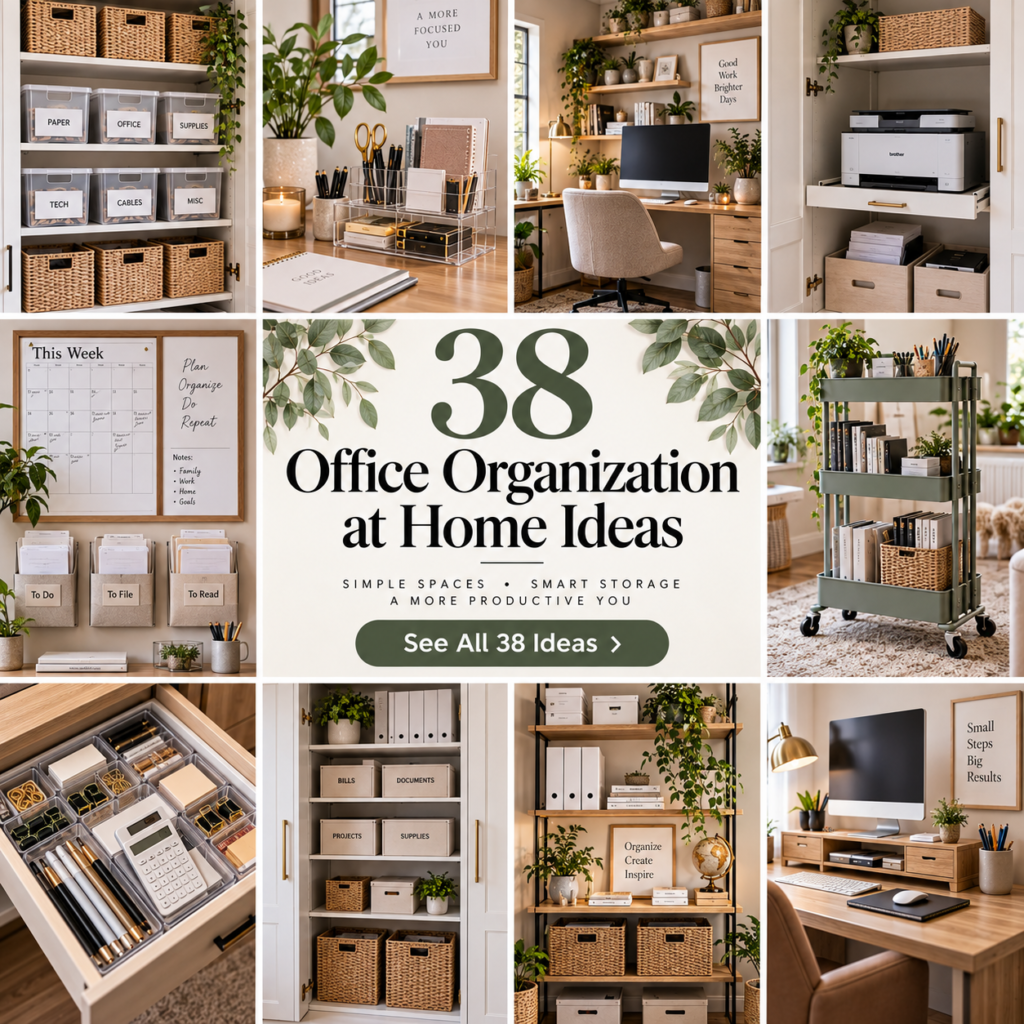
A well-planned office organization at home setup can make working, filing paperwork, managing family schedules, and storing everyday supplies feel noticeably easier. The most useful spaces do more than look tidy—they create clear homes for papers, electronics, office tools, reference materials, and the little items that usually end up scattered across a desk.
These 38 ideas range from complete office closets and built-in workstations to compact desk organizers, rolling carts, filing systems, command centers, and vertical storage. Some lean minimal and polished, while others use warm wood, baskets, plants, and decorative details to make organization feel more comfortable and personal.
The goal is not to copy every feature. Instead, use each setup as inspiration for solving the specific clutter problems in your own workspace. You might only need a better paper station, a more efficient drawer, or one wall dedicated to planning. Scroll through the ideas, notice which systems fit your habits, and build an office that supports the way you actually work.
Good office organization at home combines easy-access storage, clear categories, an uncluttered work surface, and systems that are simple enough to maintain. Prioritize daily essentials near your desk, move occasional supplies into labeled storage, and create dedicated zones for paperwork, printing, devices, and planning so clutter has fewer chances to build up.
1. Turn an Office Closet Into a Complete Supply Hub
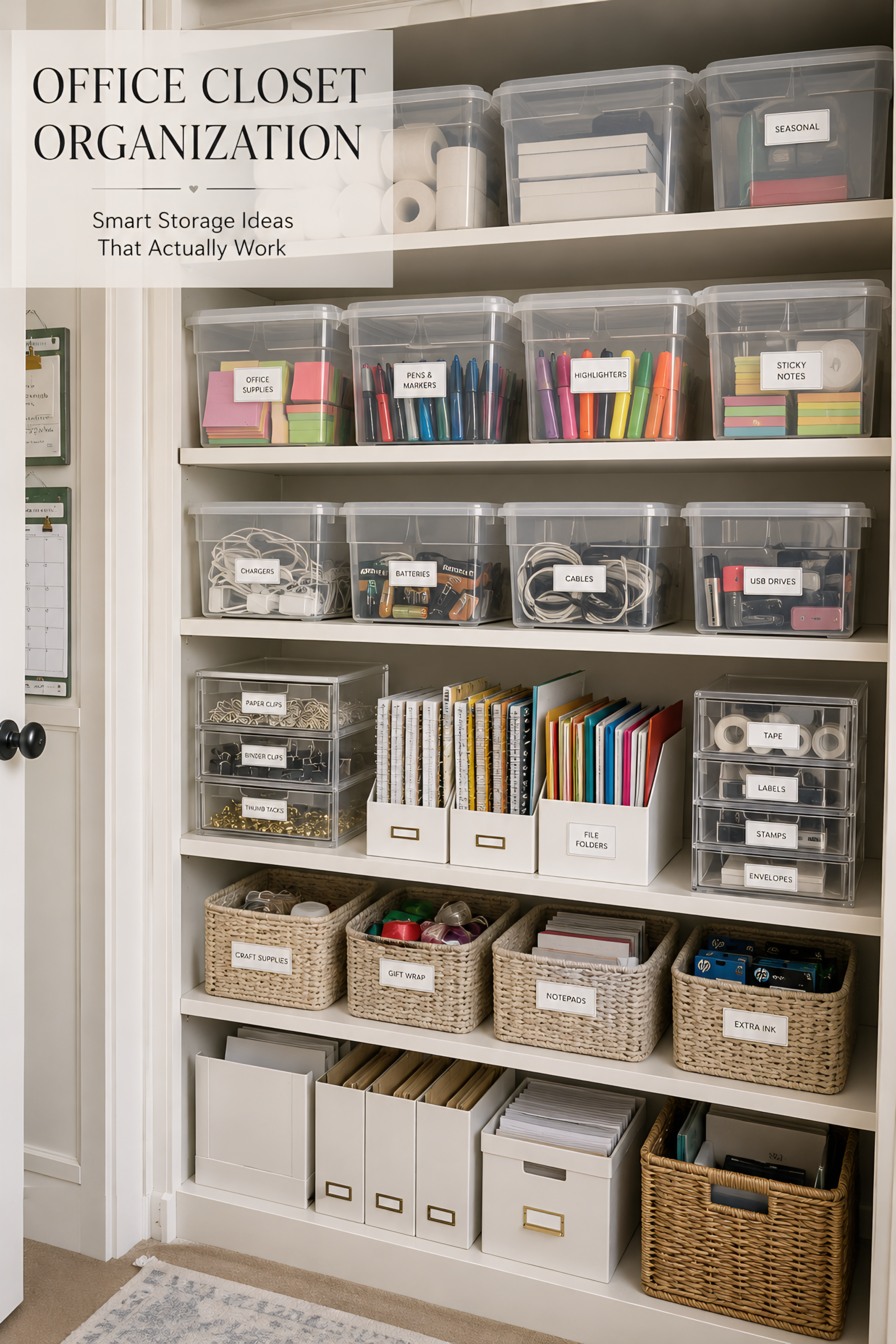
A dedicated closet can absorb an impressive amount of office clutter while keeping everything easy to find. Clear bins, labeled categories, baskets, drawers, and upright files create a structured system without wasting shelf space. This direction works especially well if your office lacks built-in storage or doubles as another room. Use this setup as inspiration for turning one overlooked closet into your main organization zone.
2. Keep a Small Desk Light With Clear Acrylic Storage
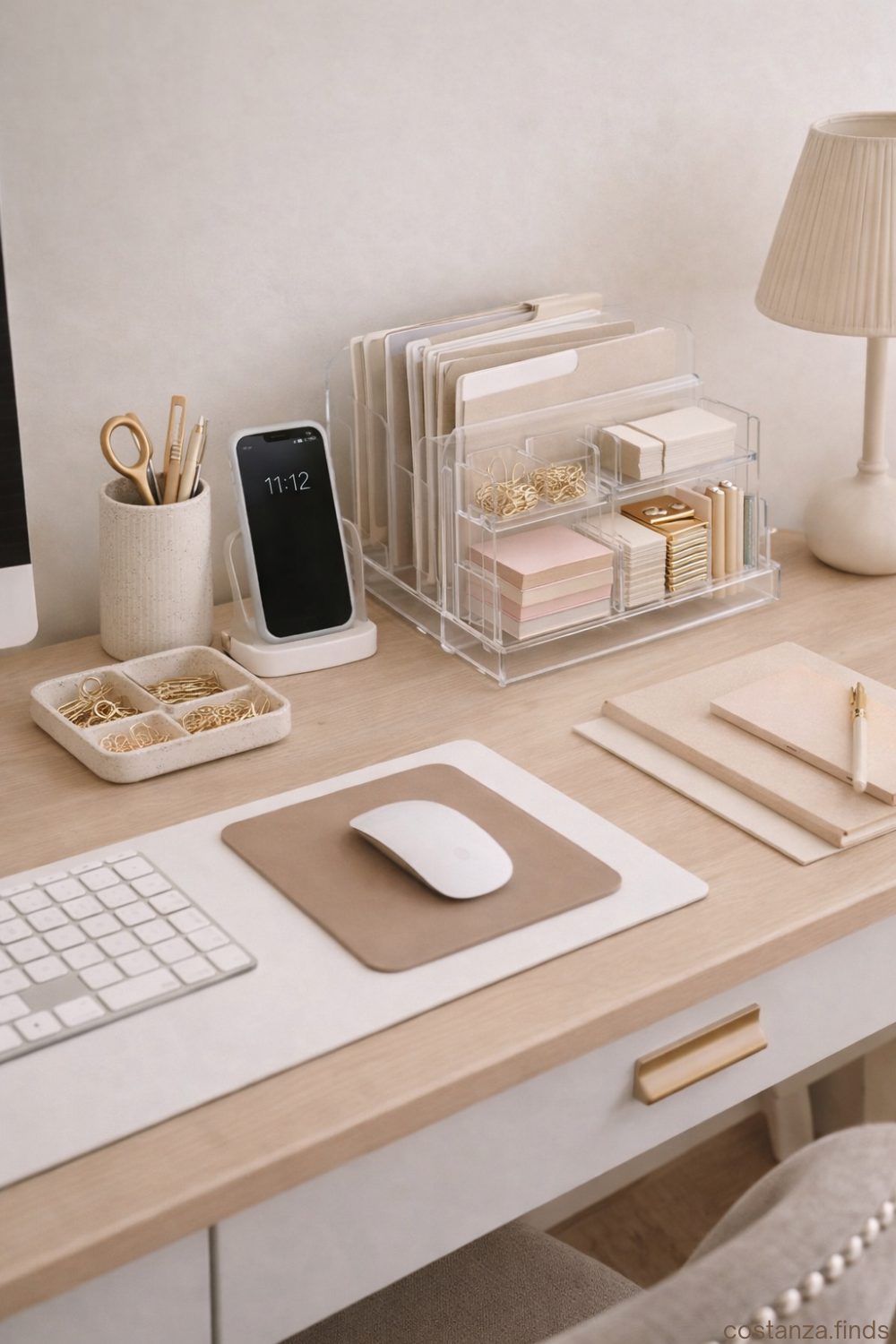
Transparent organizers are ideal when you need storage without adding visual weight. Papers, notebooks, clips, and small stationery pieces stay contained while the desktop still feels open and calm. The neutral palette makes this approach especially adaptable to bedrooms or compact home offices. Borrow this idea if you want your everyday tools close at hand without making your workspace look crowded.
3. Combine Cozy Decor With Practical Cubicle Organization
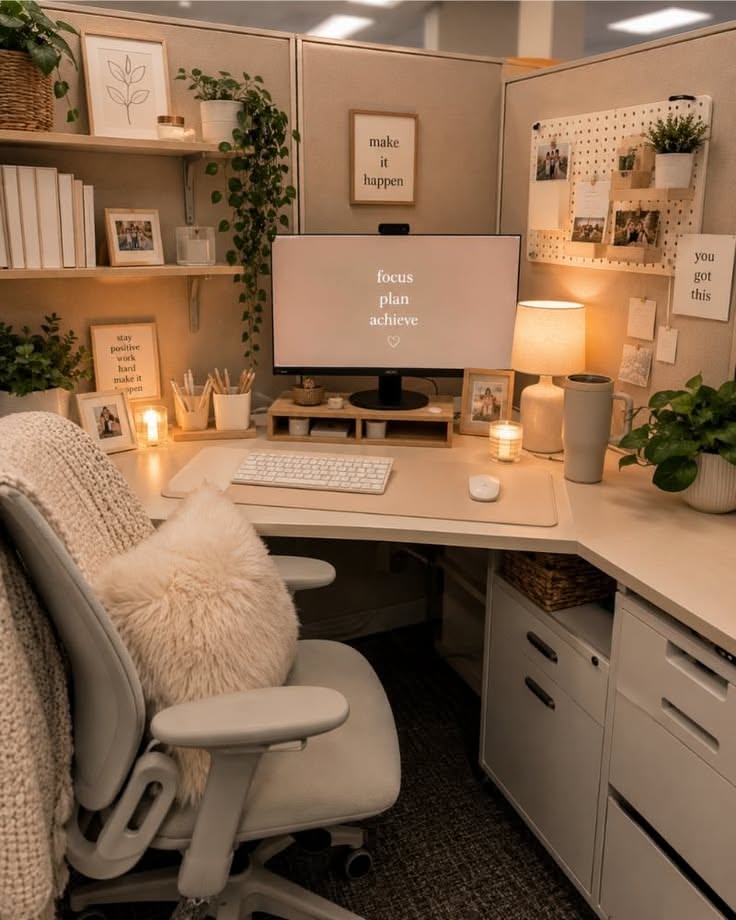
Organization does not need to make a workspace feel corporate or sterile. Shelves, a pegboard, desk storage, plants, warm lighting, and personal touches turn this compact workstation into a comfortable place to focus. The key is giving practical objects designated zones while still leaving room for personality. Keep this setup as a reference if you want your office to feel productive and genuinely inviting.
4. Hide a Bulky Printer Inside Cabinet Storage
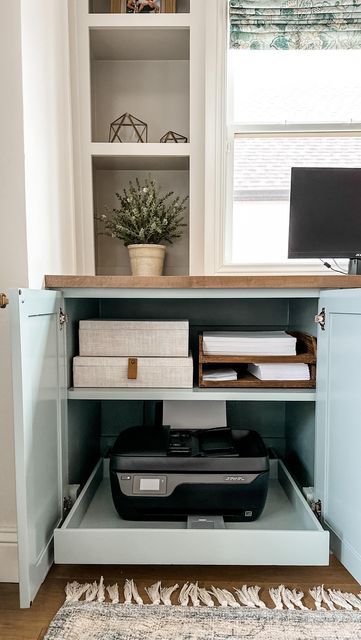
Printers can dominate a room visually, so concealing one inside a cabinet is a smart way to create a cleaner office. A pull-out shelf keeps the machine accessible while allowing the cabinet doors to hide it when work is finished. The remaining shelves can hold paper and related supplies nearby. Consider this solution when you want technology available without letting it define the entire room.
5. Create a Calm Filing System With Matching Binders
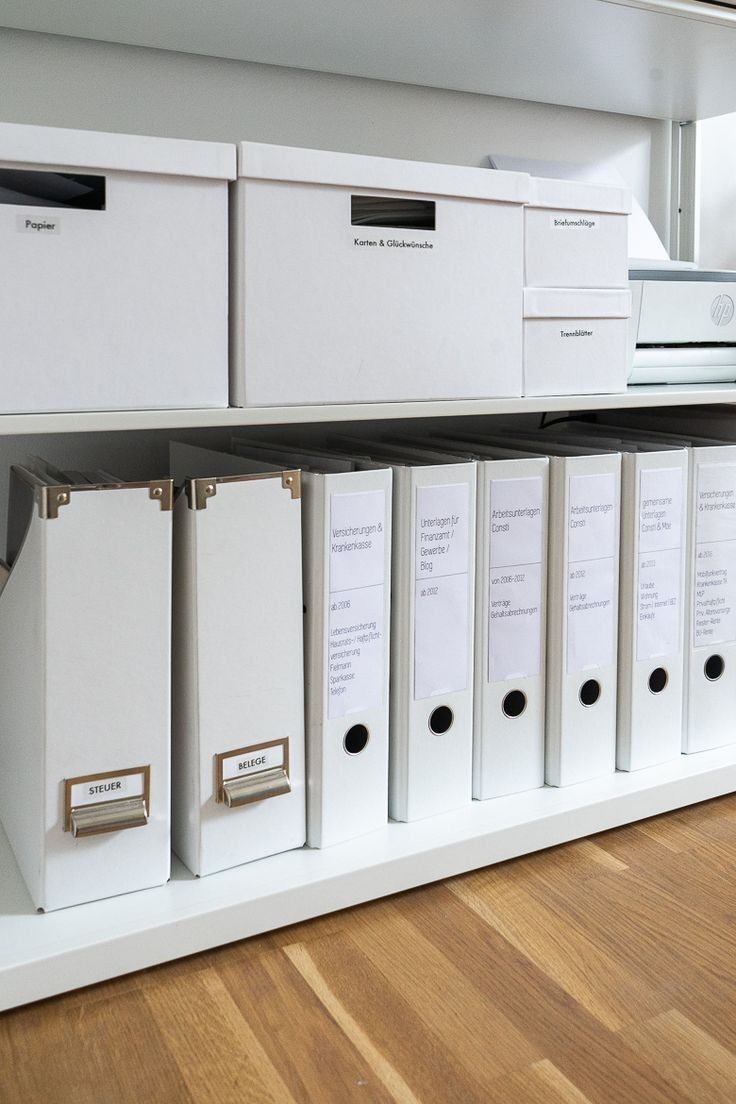
Uniform binders and boxes can make paperwork feel far more manageable because the shelving reads as one organized system instead of a collection of random items. Clear labels also reduce the time spent searching for documents. This approach is especially useful for financial, household, or long-term records. Adapt this idea by creating only the categories you regularly need rather than overcomplicating the filing process.
6. Build One Dedicated Printer and Craft Supply Station
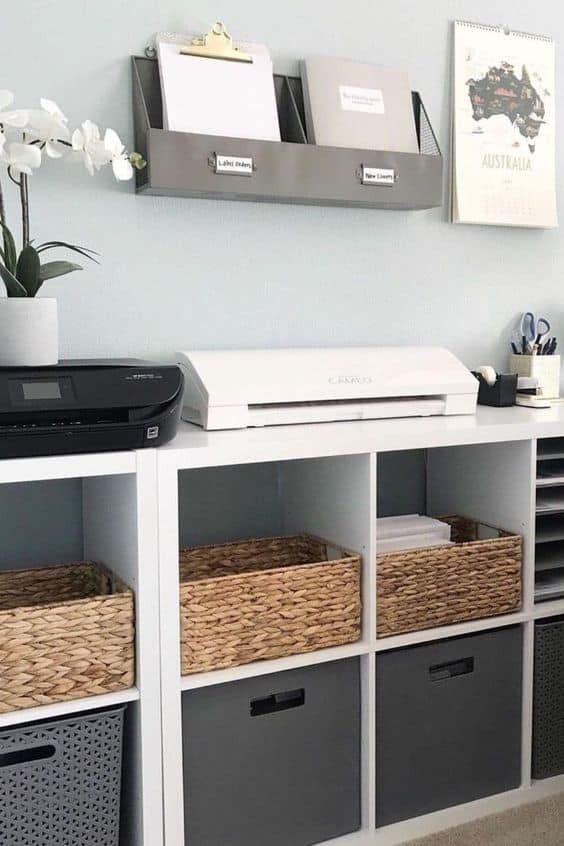
Grouping printers, cutting tools, baskets, paper, and office accessories into one storage unit keeps related tasks from spreading across the room. Open cubbies make frequently used supplies easy to reach, while baskets hide smaller pieces that would otherwise look messy. This is a practical choice for creative workspaces. Save this concept for a corner that needs to handle both office tasks and hobby supplies.
7. Turn a Bulletin Board Into Functional Wall Organization
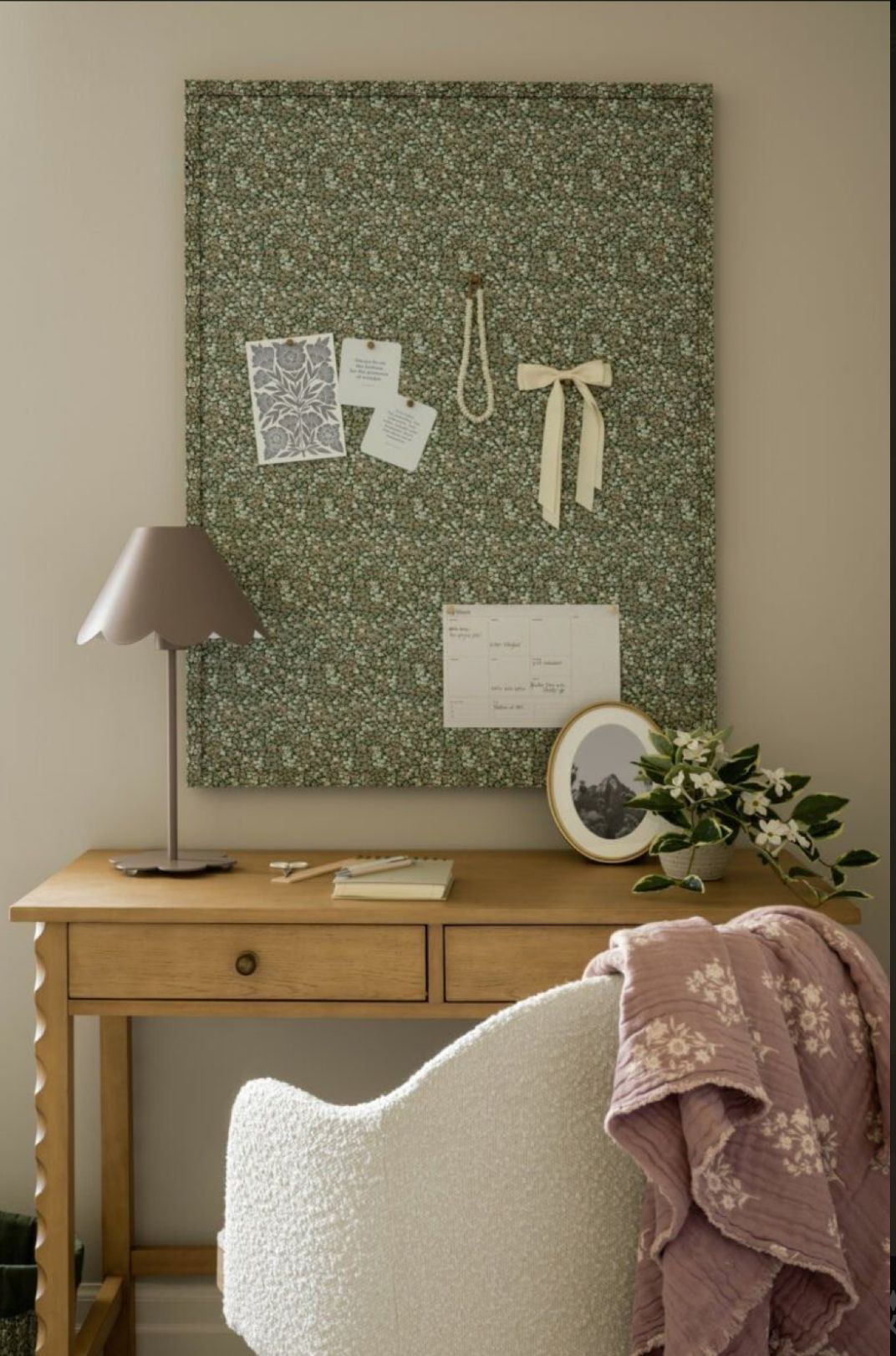
A fabric-covered pinboard gives notes, reminders, schedules, and inspiration a visible home while doubling as wall decor. It is particularly useful when you prefer seeing important information instead of storing everything in drawers. The soft pattern keeps the practical element from feeling too utilitarian. Make this idea your own with a fabric or color that complements the rest of your workspace.
8. Keep Family Documents Together in Clearly Defined Categories
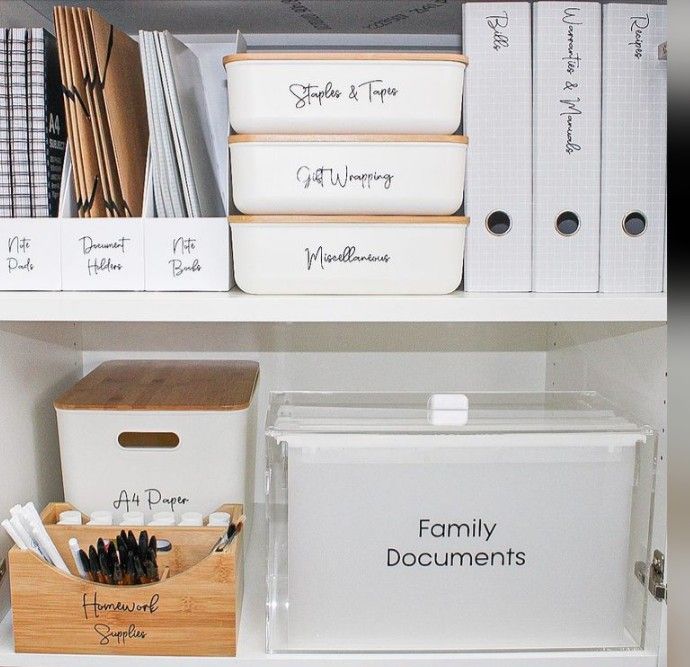
Household paperwork becomes easier to manage when files, paper supplies, and important records are grouped in one dedicated area. This shelving system uses labeled boxes, binders, and file storage to keep categories separate and accessible. It is a strong solution for anyone whose home office also handles family administration. Use this as inspiration for creating one reliable place for documents you cannot afford to misplace.
9. Create a Wall-Based Productivity Command Center
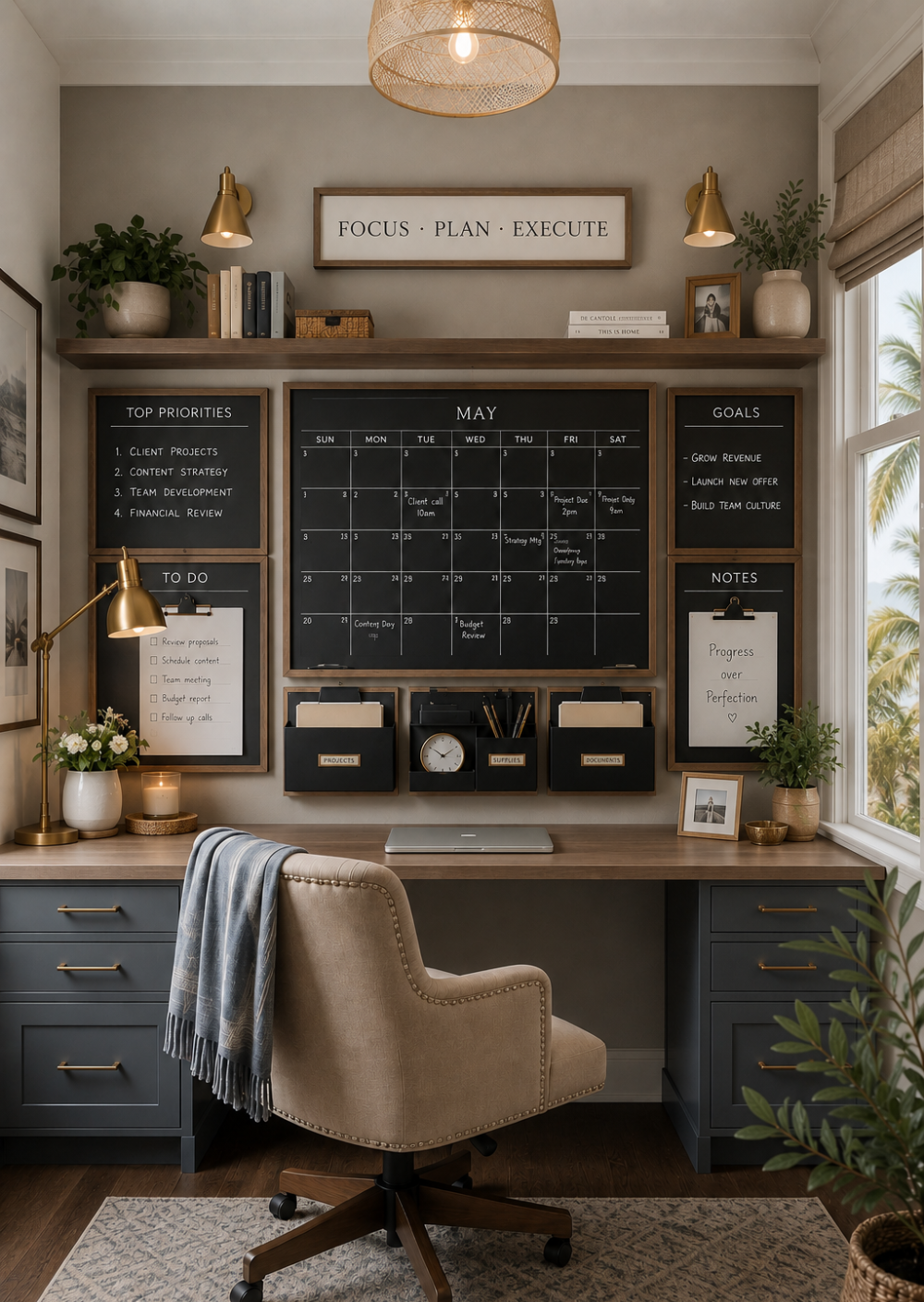
A command wall turns planning into something visible and actionable. Calendars, goal boards, task lists, document holders, and desk storage work together so important information stays in sight without covering the desk itself. This type of setup suits people who manage several projects at once. Bookmark this direction if you work best when priorities, deadlines, and notes are displayed rather than hidden away.
10. Mix Wall Storage, Calendars, and Desk Organization
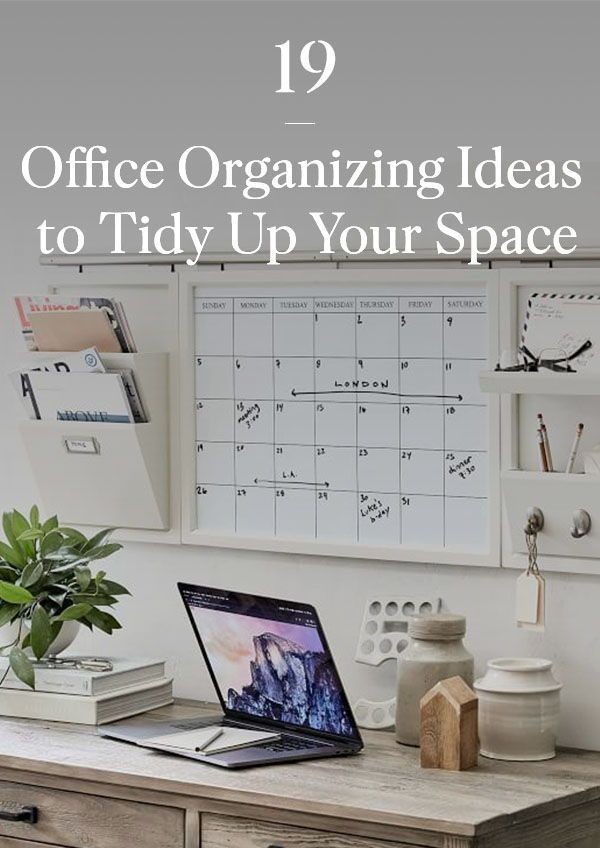
This office organization concept shows how a workspace can combine planning surfaces with desktop storage instead of relying on one organizing method. Wall pockets keep papers vertical, the calendar creates an obvious scheduling zone, and the desk stays available for active work. It is a useful reminder that several small systems can work together. Save this approach if your office needs better structure from floor to wall.
11. Use Vertical Organization to Make a Small Office Work Harder
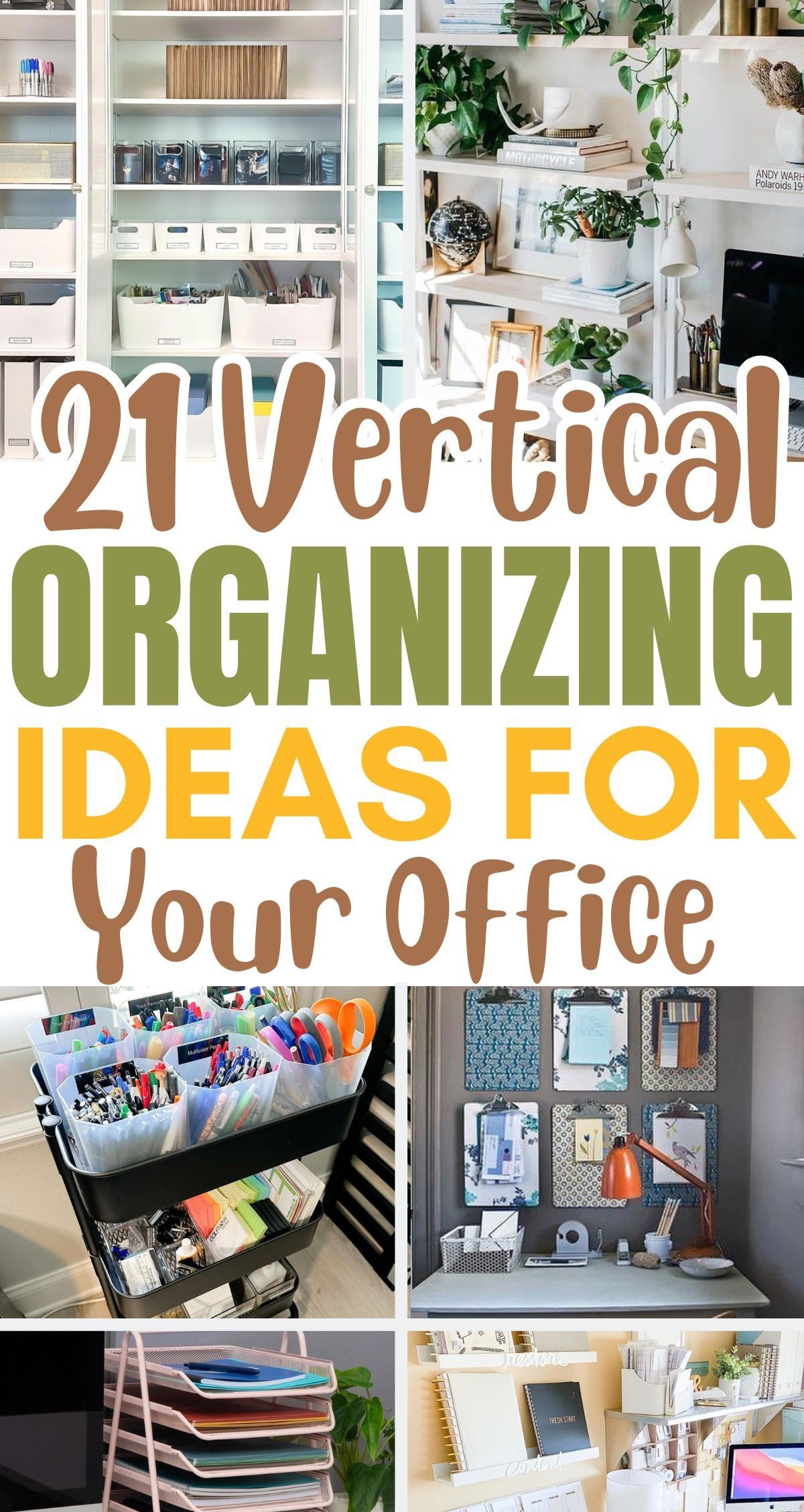
When floor space is limited, vertical storage can dramatically expand what a small office can hold. Shelves, wall organizers, stacked trays, carts, and upright paper systems all help move supplies away from the main work surface. The result is more usable desk space without sacrificing accessibility. Add this concept to your inspiration board if your current office feels crowded despite having relatively few supplies.
12. Maximize Desk Space With Compact Storage Accessories
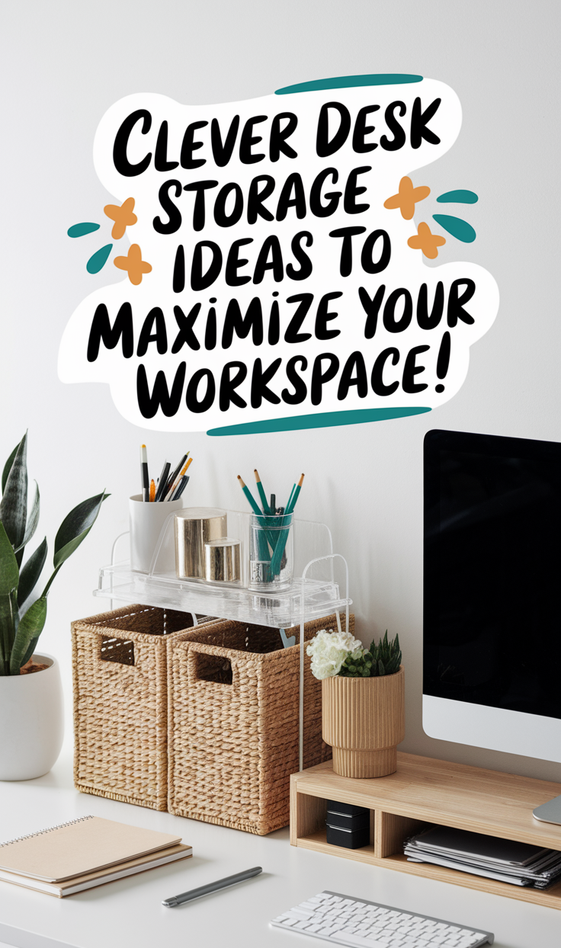
Small baskets, clear risers, monitor stands, and pen holders can create surprisingly useful layers of storage around a desk. This strategy is especially effective when you cannot add large furniture or permanent shelving. Every item earns a defined place while the center of the desk remains available for work. Try this direction when you want a meaningful organization upgrade without completely redesigning the room.
13. Give Paperwork a Proper File Drawer System
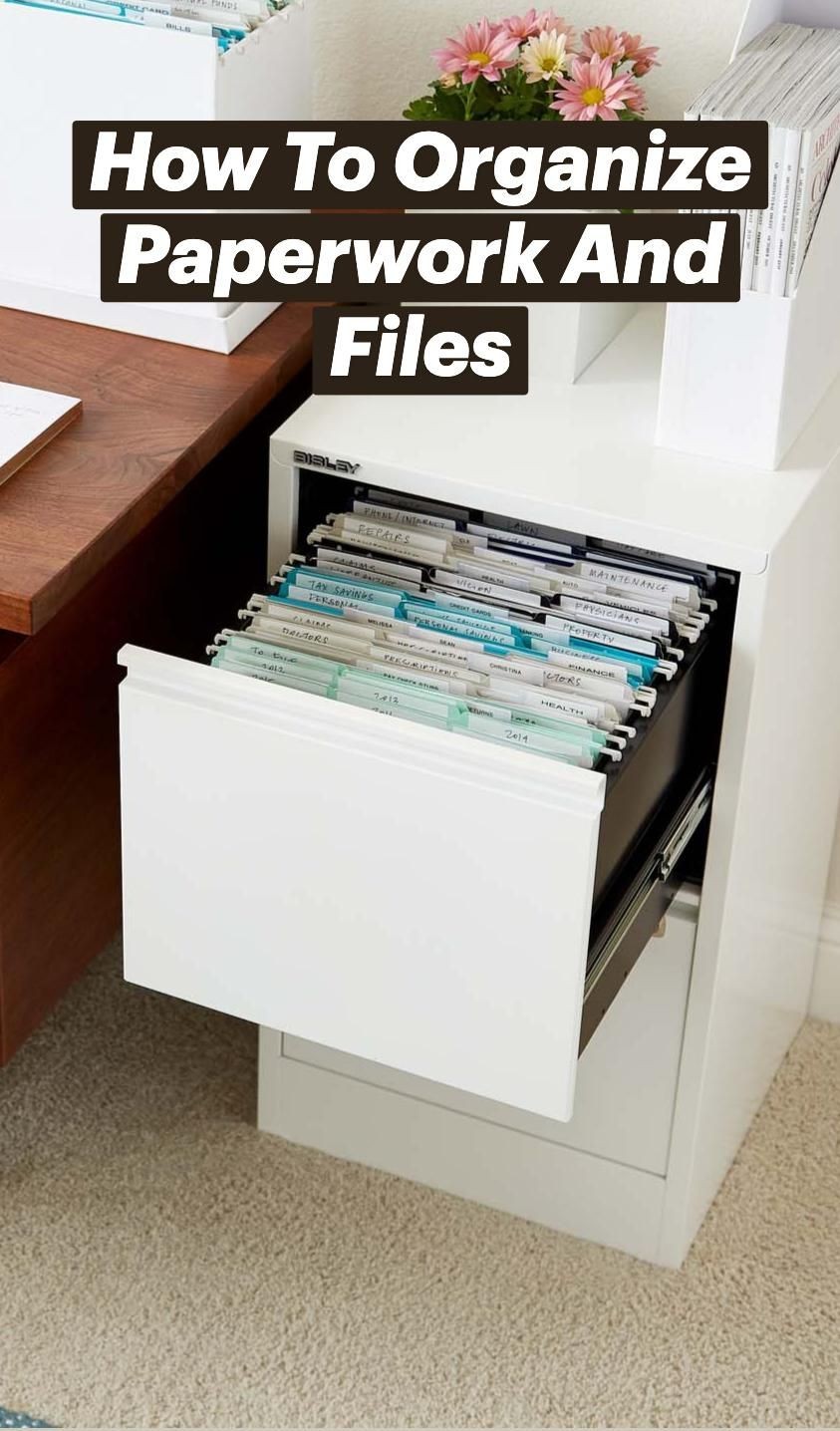
A dedicated filing drawer is one of the simplest ways to stop important papers from becoming piles. Hanging folders allow categories to stay upright, separated, and easy to scan whenever you need a document. The system works especially well for household records, taxes, medical files, or recurring paperwork. Use this idea to replace scattered paper stacks with one reliable filing destination.
14. Make Large Shelves Look Organized With Repeating Containers
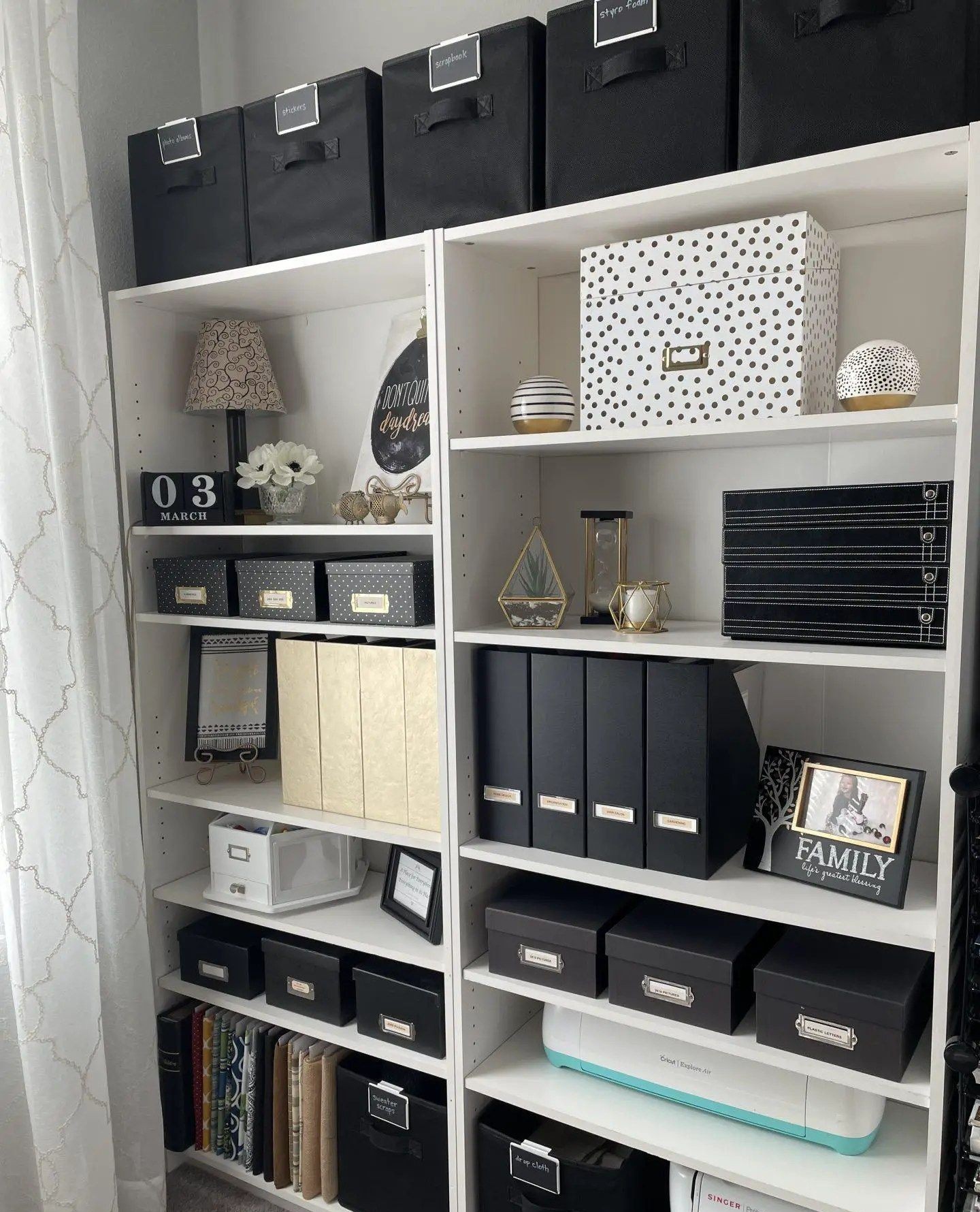
Open shelving can hold a huge amount of office material without feeling chaotic when boxes, binders, and files repeat in a consistent palette. Here, black-and-white storage creates strong visual order while leaving space for a few decorative pieces. This works beautifully in offices where storage remains visible all day. Recreate the principle by choosing a limited container style and repeating it across your shelves.
15. Add a Rolling Cart for Supplies That Need to Move
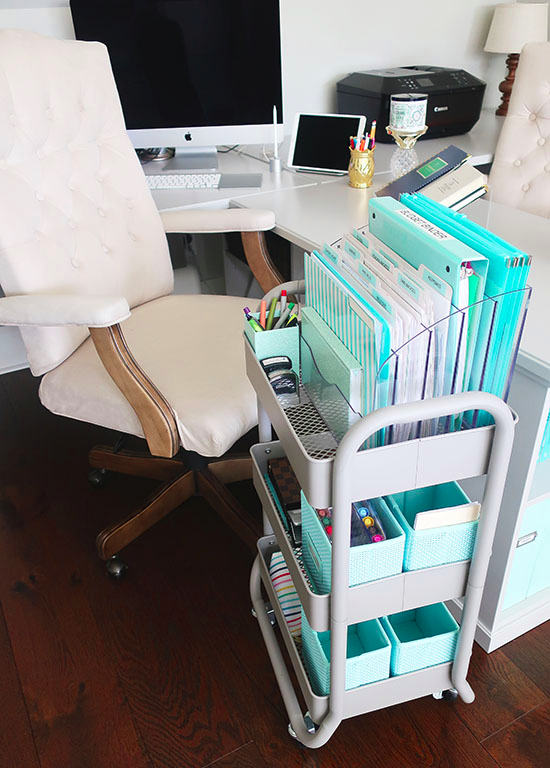
A rolling cart gives folders, notebooks, pens, and smaller office essentials a flexible home that can move with your workflow. It is especially practical in shared rooms or offices where one desk cannot hold everything. Because the cart can be pushed aside when not needed, it also helps preserve valuable floor space. Keep this idea handy if your ideal storage needs to be mobile rather than permanent.
16. Protect Focus With a Deliberately Minimal Desktop
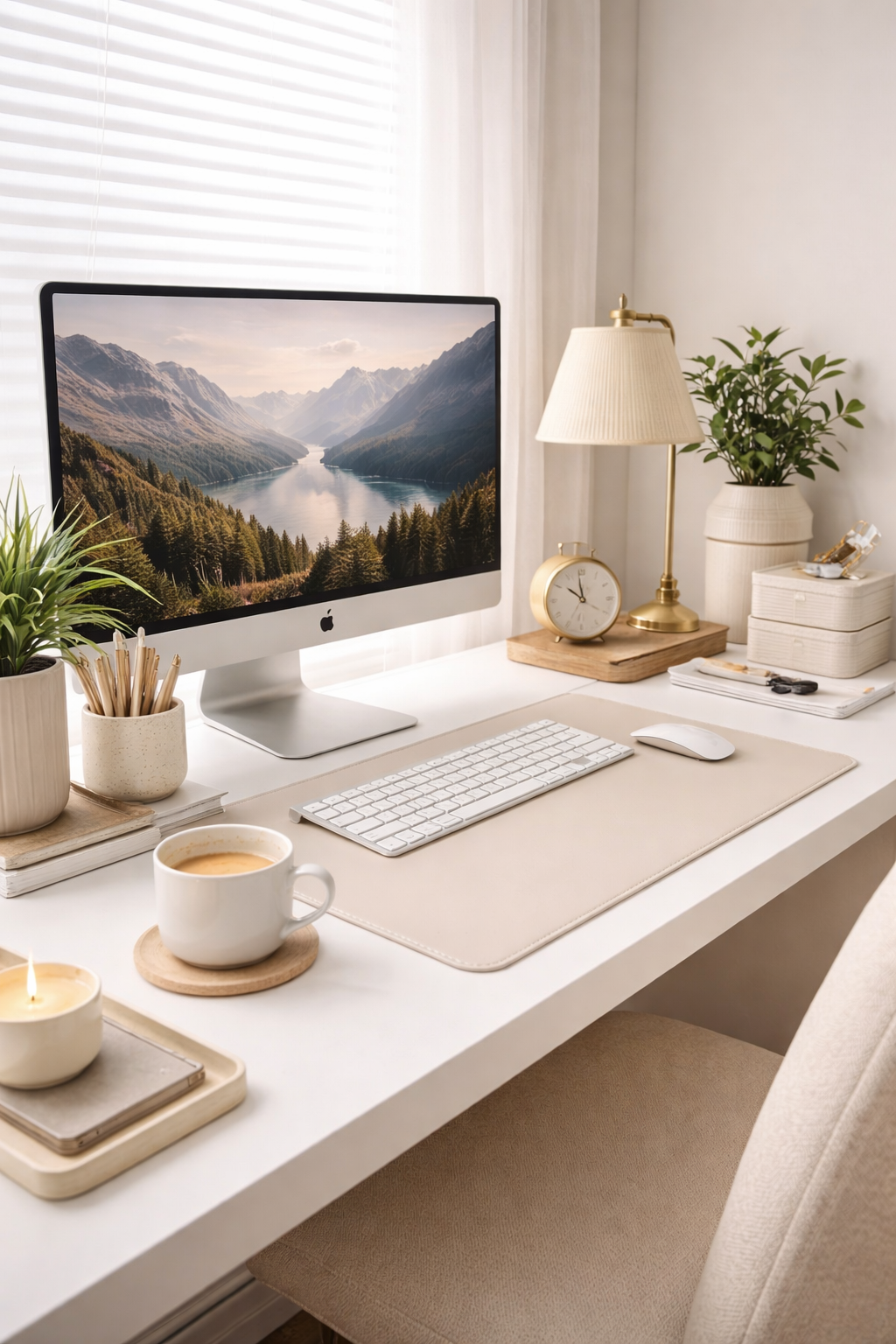
A nearly clear desk creates visual breathing room and makes it easier to reset the workspace after each session. This arrangement keeps technology and a few useful accessories within reach while allowing open surface area to dominate. The combination feels peaceful rather than empty. Use this setup as a reminder that office organization at home sometimes means removing items instead of adding more storage products.
17. Corral Creative Tools in Simple Everyday Containers
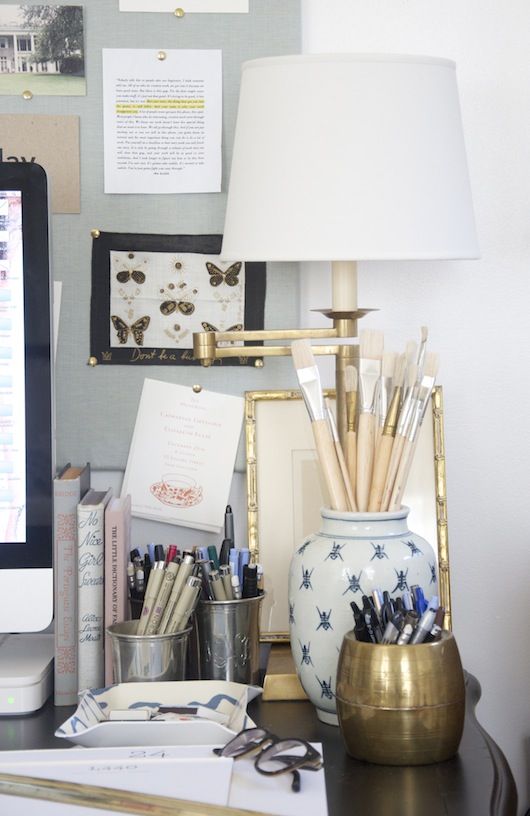
Pens, markers, brushes, scissors, and small creative tools are easiest to use when they remain visible but contained. Cups, trays, and jars turn loose supplies into purposeful groups without requiring complicated systems. This is particularly helpful for artistic or mixed-use workspaces where tools change frequently. Adapt this approach if you prefer open-access organization that still keeps the desk from becoming completely scattered.
18. Turn a Cube Shelf Into a Practical Printer Station
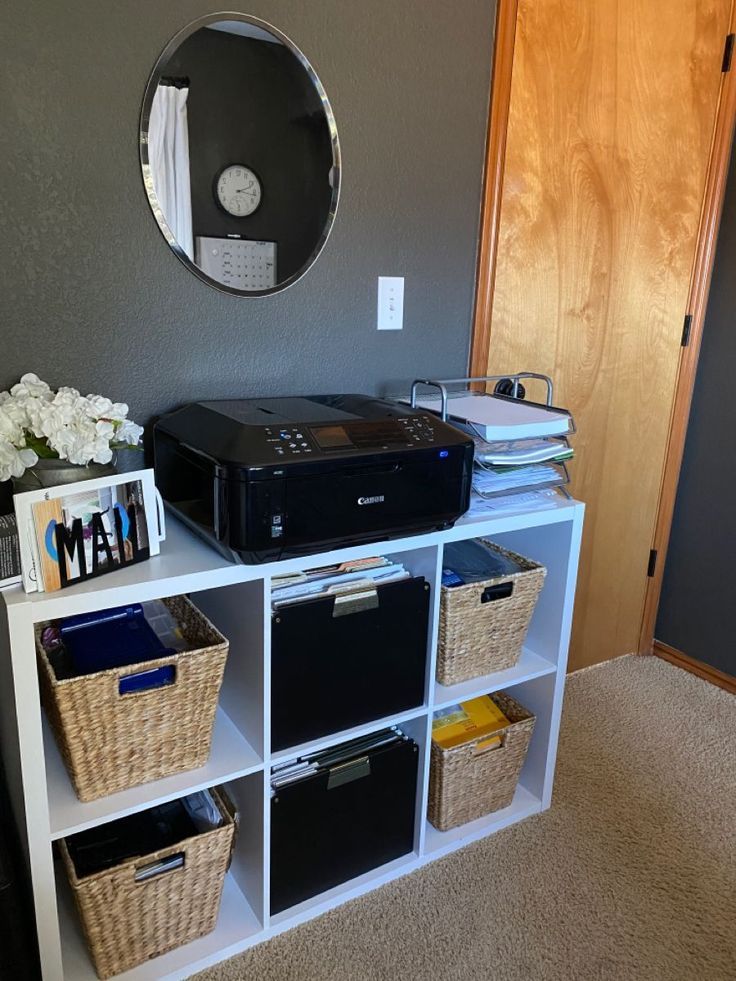
A compact cube unit can create a surprisingly capable office station by combining printer space, baskets, trays, and file storage in one footprint. The open compartments allow frequently used materials to stay visible while woven baskets conceal less attractive supplies. It is an accessible alternative to custom cabinetry. Save this example if you need an affordable way to organize one hardworking office corner.
19. Build a Household Command Center Beside Everyday Living Areas
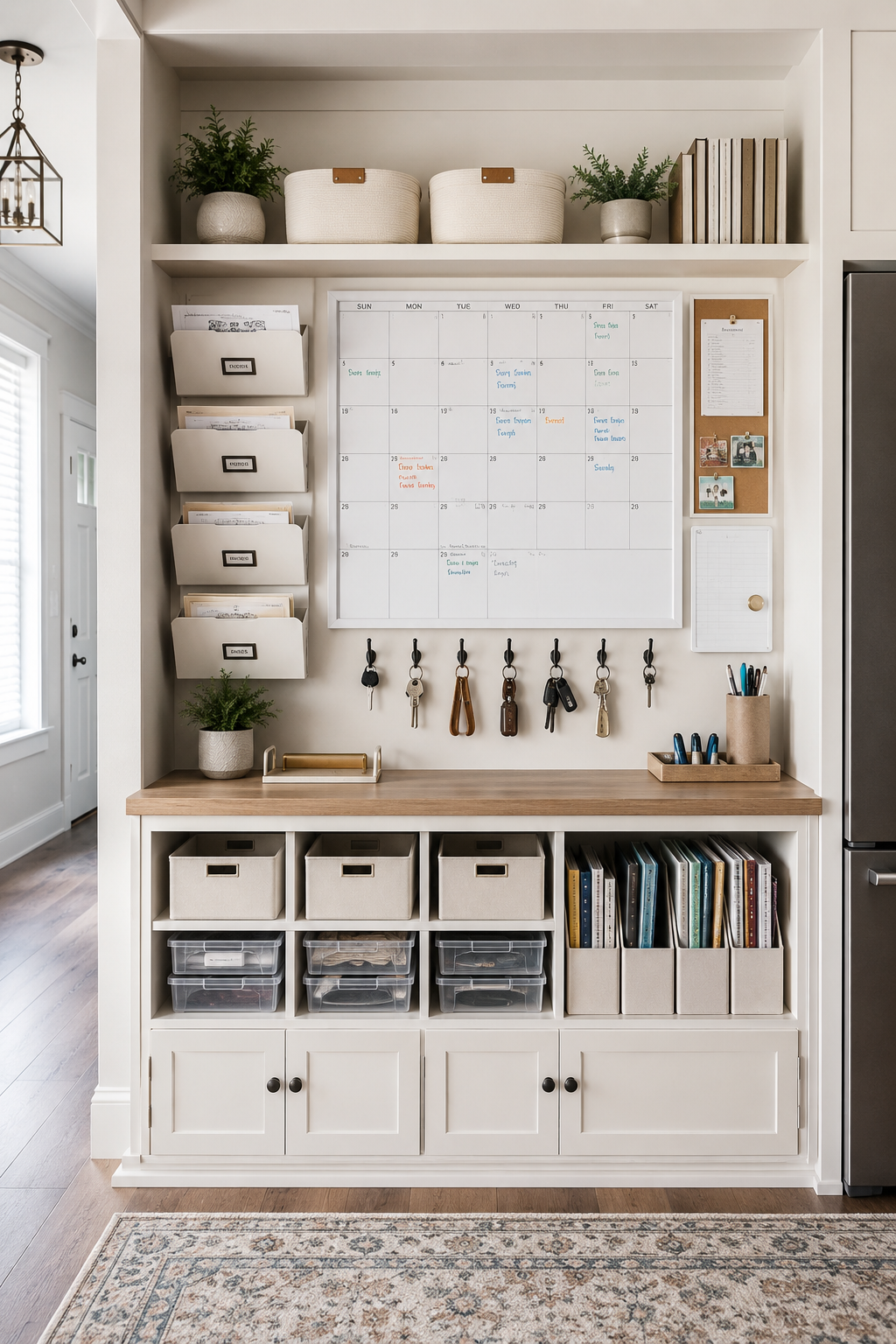
An office organization zone does not always need to live inside a formal office. This built-in command center combines a monthly calendar, mail pockets, hooks, storage bins, books, and concealed cabinets in a central household location. It makes schedules and frequently used documents easy to access. Consider this concept when your home office responsibilities naturally overlap with family planning and household management.
20. Dedicate Full-Height Shelving to Creative and Paper Supplies
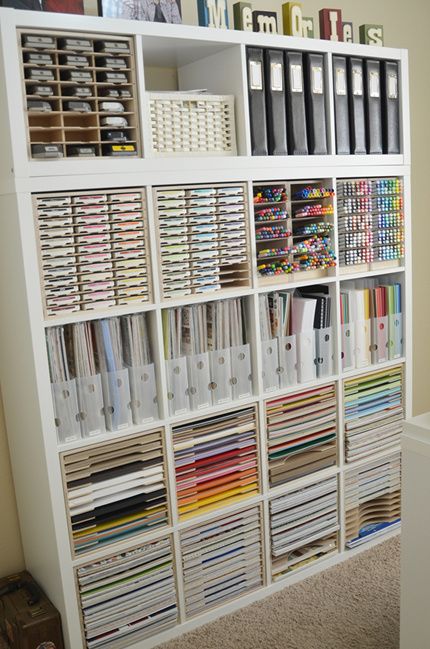
A tall shelving unit can turn a large collection of paper, pens, binders, and project supplies into an organized visual library. The strongest feature here is separation: different materials have individual compartments, preventing one category from taking over another. This approach suits anyone with a craft-heavy or paper-heavy workflow. Bookmark it if your supplies have outgrown small drawers and tabletop containers.
21. Create a Family Planning Station With Individual Drop Zones
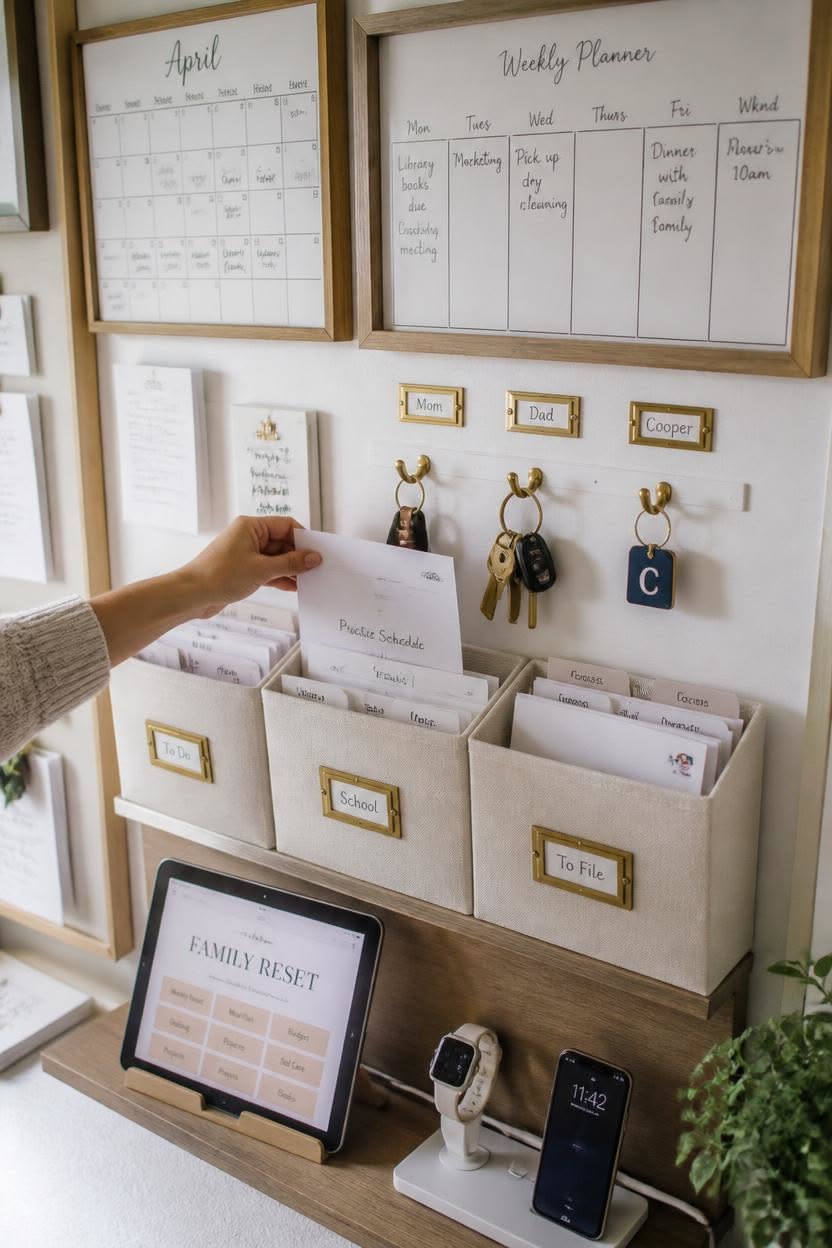
Calendars, keys, paperwork, charging devices, and family schedules become easier to manage when each function has a defined position. Separate labeled pockets prevent school papers, action items, and filing from becoming one mixed stack. Hooks give frequently used keys a permanent home as well. Use this layout as inspiration if you want one organized landing zone that supports both work and family routines.
22. Sort Incoming Paper With Wall-Mounted Mesh Pockets
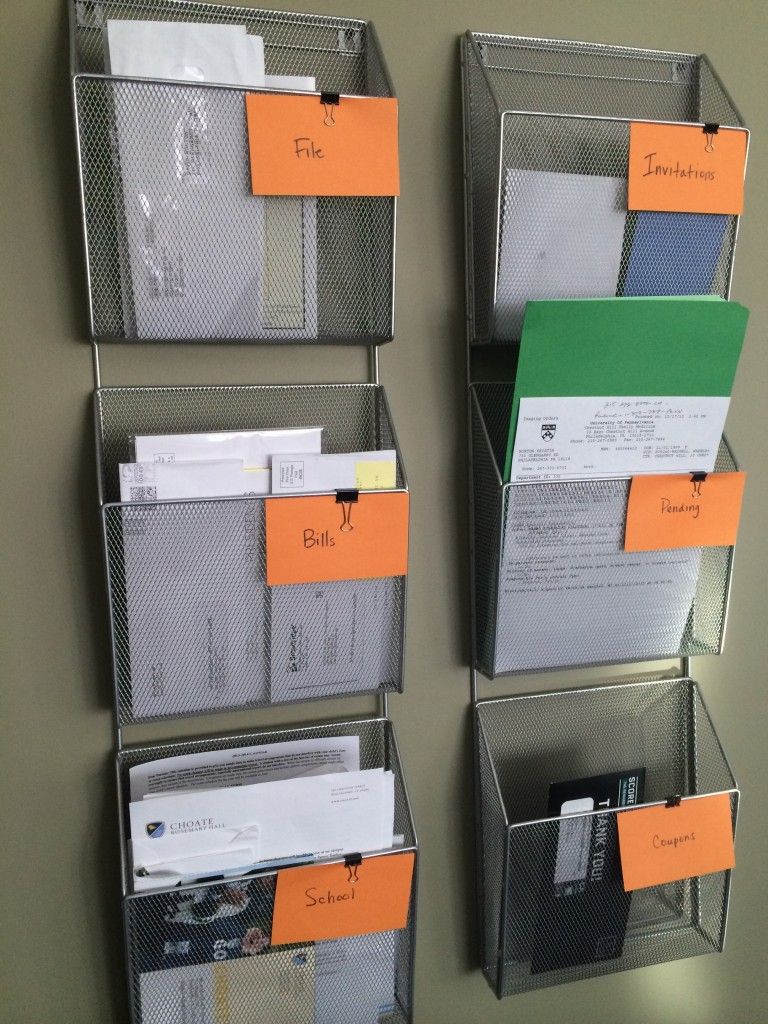
Vertical mail pockets are a smart way to handle bills, invitations, pending documents, and files before they reach the desk. Because categories remain visible, papers are less likely to disappear into an unmanageable pile. This solution uses almost no floor or desktop space, making it excellent for compact offices. Try this method if incoming paperwork is the main source of clutter in your workspace.
23. Organize the Office Around Specific Functional Stations
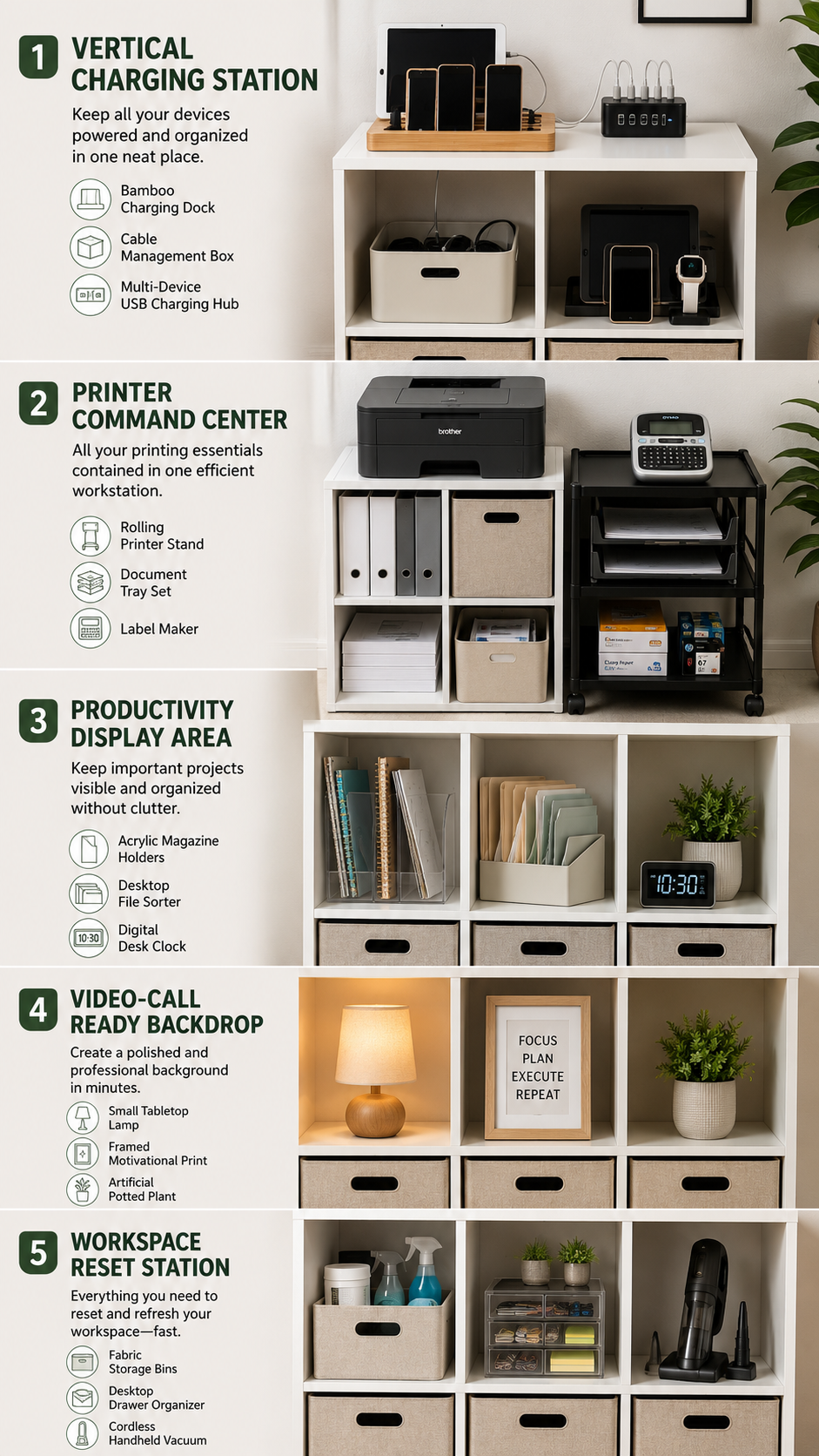
Breaking a home office into mini zones can make a busy room much easier to maintain. Charging, printing, active projects, video calls, and workspace resets each have different storage needs, so treating them separately prevents unrelated supplies from mixing together. This is especially effective in multifunctional offices. Use this zoning concept as a checklist when planning your next organization overhaul.
24. Balance Decorative Shelving With Serious Storage Capacity
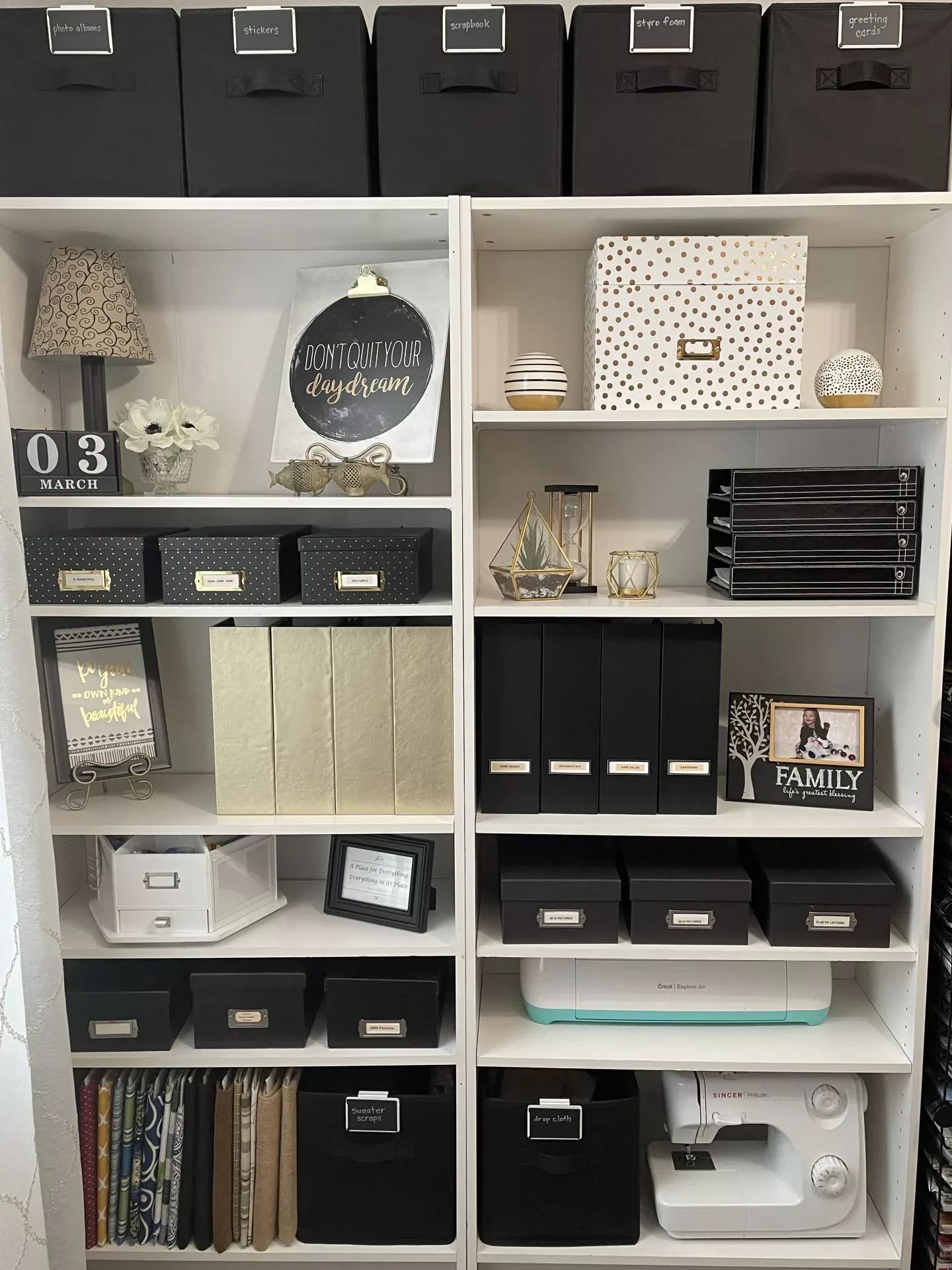
Large shelving feels much more intentional when decorative objects and office storage are given separate roles. Matching black boxes, binders, trays, and fabric bins provide substantial storage, while selected display pieces keep the shelves from feeling purely functional. This balance works well in offices that are visible from other living areas. Save this setup if you want organization that still looks styled and finished.
25. Use Warm Wood and Woven Storage for a Softer Home Office
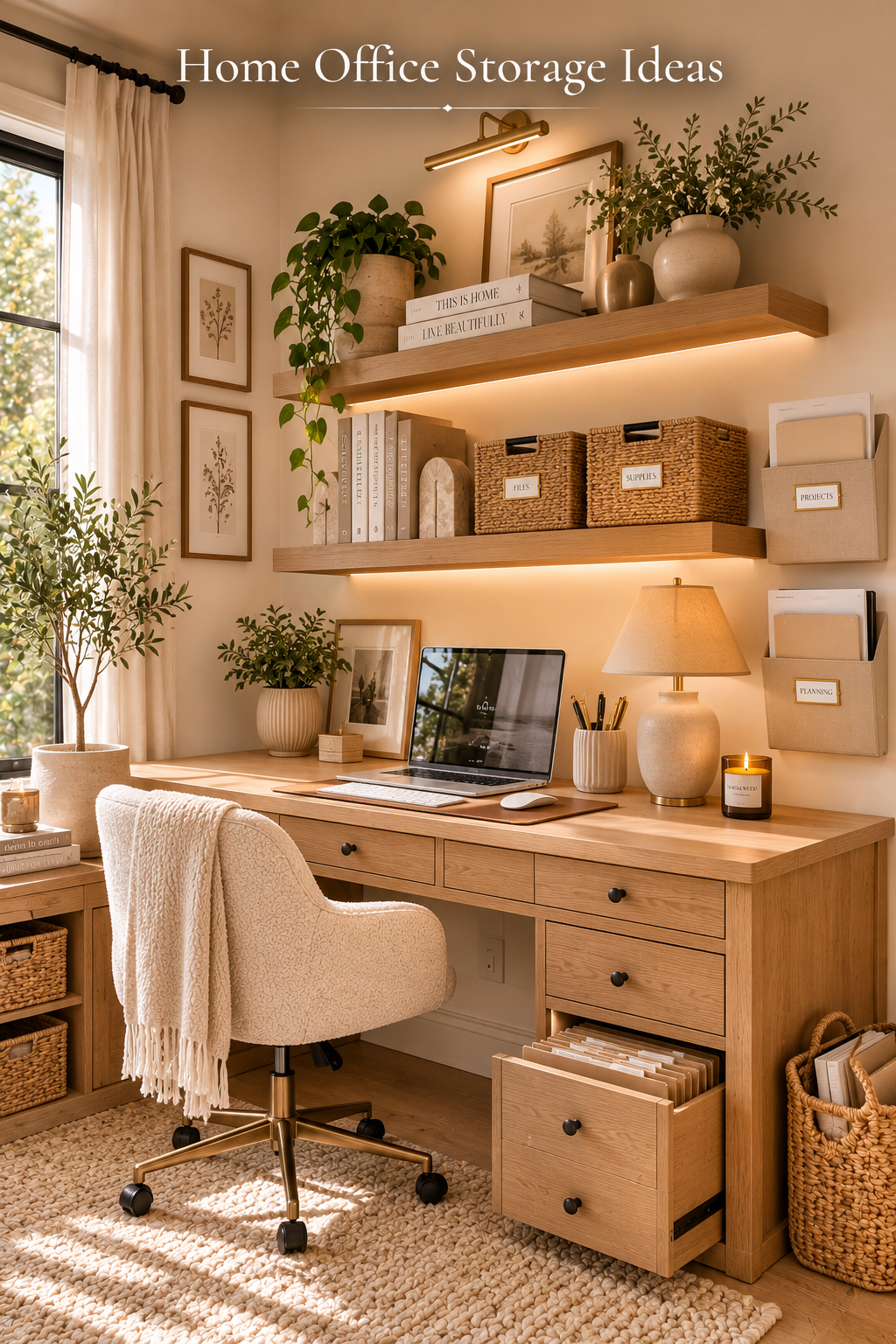
Wood shelving, drawers, woven baskets, and neutral wall pockets create storage without making this office feel institutional. The warm finishes soften practical systems and help the room blend naturally with residential interiors. It is a strong direction if traditional office furniture feels too cold for your home. Let this setup inspire a workspace where organization and comfort feel equally important.
26. Give Every Desk Drawer Item Its Own Compartment
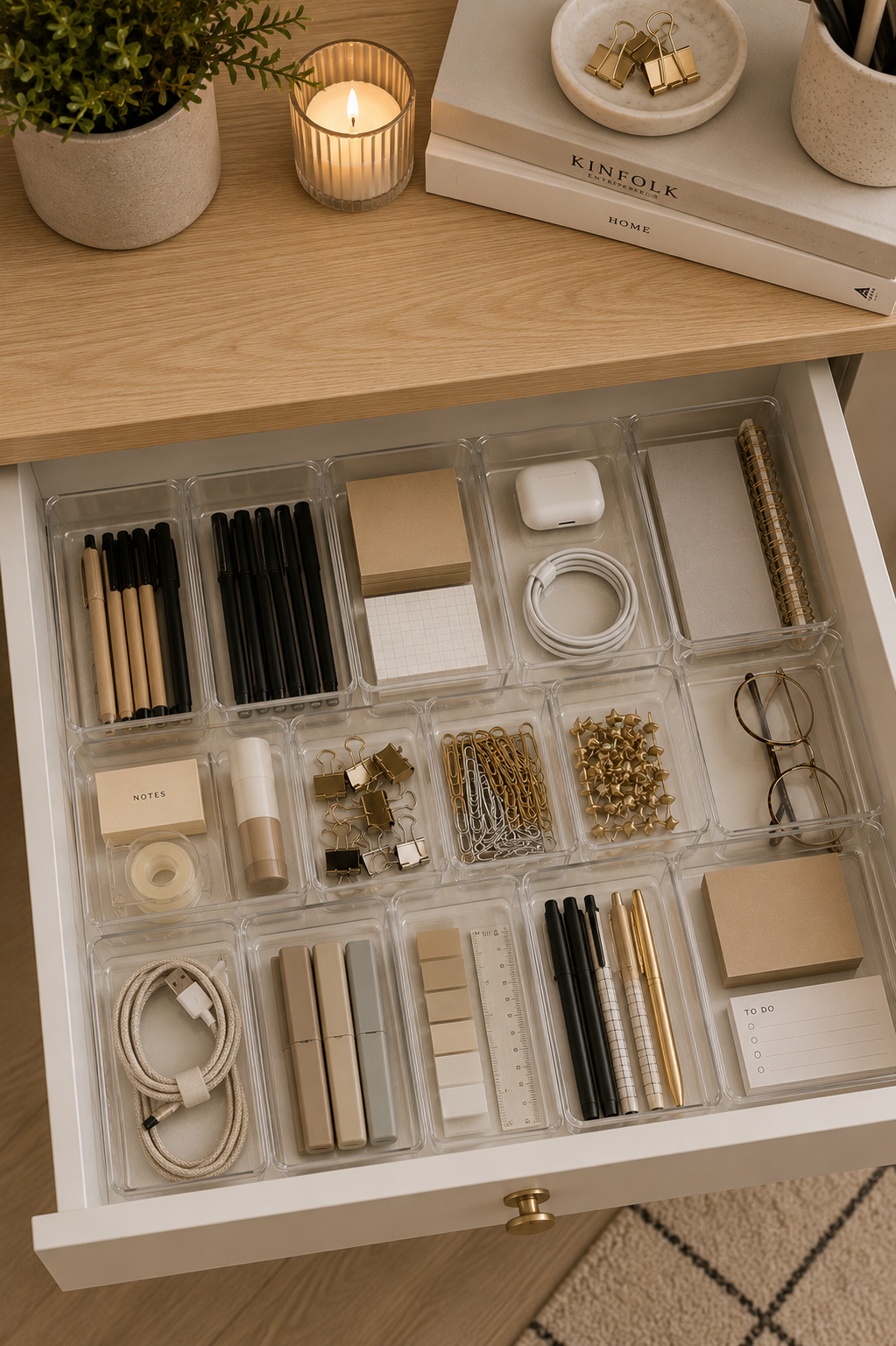
Clear modular trays make a deep drawer far more useful by preventing cords, pens, clips, notebooks, and small tech from sliding together. The transparent design also lets you identify everything at a glance, which speeds up both work and cleanup. This is one of the easiest organization ideas to scale up or down. Use this drawer as a reference for your next small-space reset.
27. Keep a Technology-Heavy Office Visually Calm
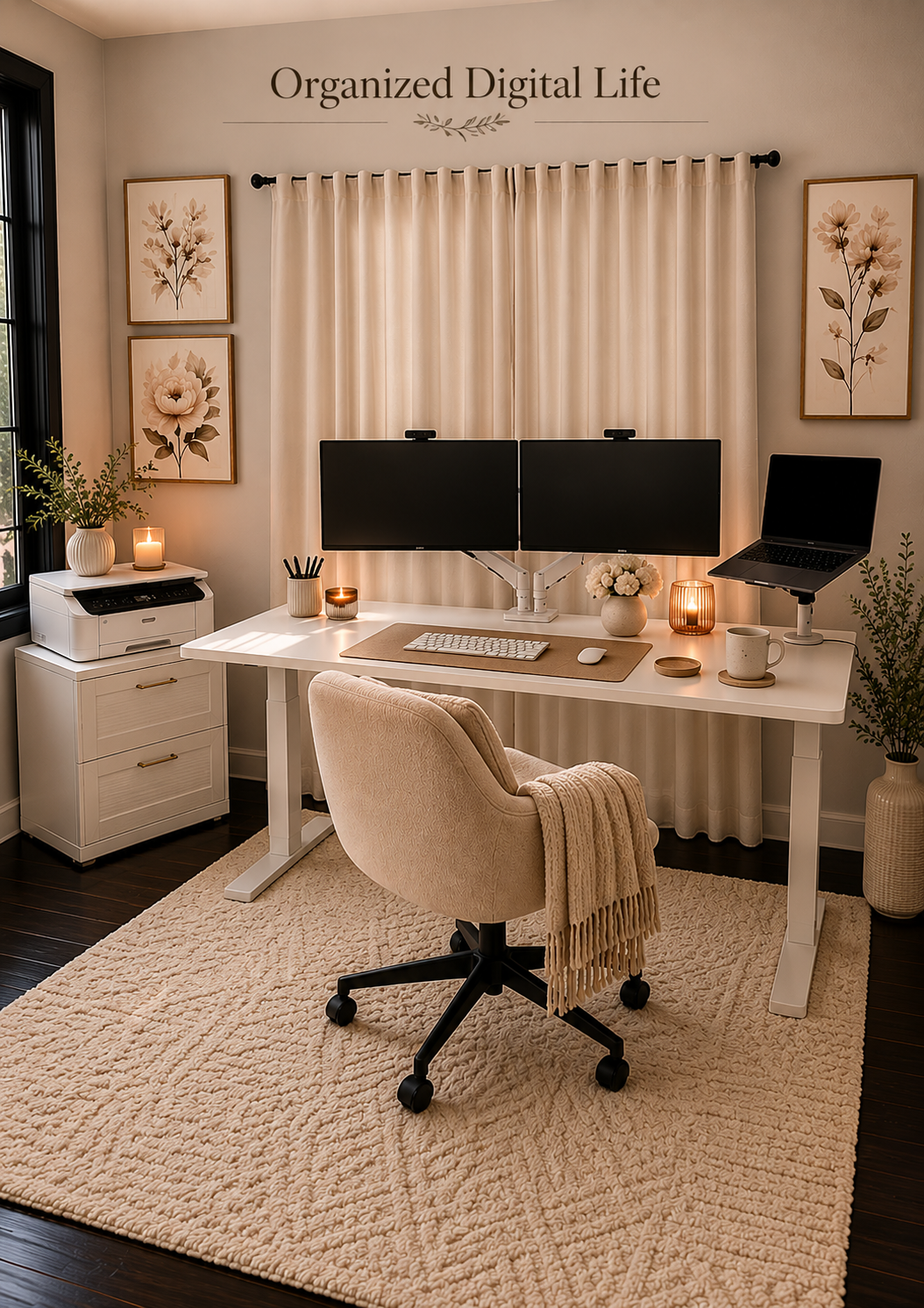
Multiple screens and devices can make a home office feel cluttered quickly, but a controlled desktop and intentional furniture layout help technology look streamlined. This workstation keeps the central surface open while larger equipment remains neatly positioned around it. Soft textiles and warm lighting also reduce the harsh feel of electronics. Pin this direction if your work requires substantial technology but you still want visual calm.
28. Use a Large Desk Without Letting the Surface Become Storage
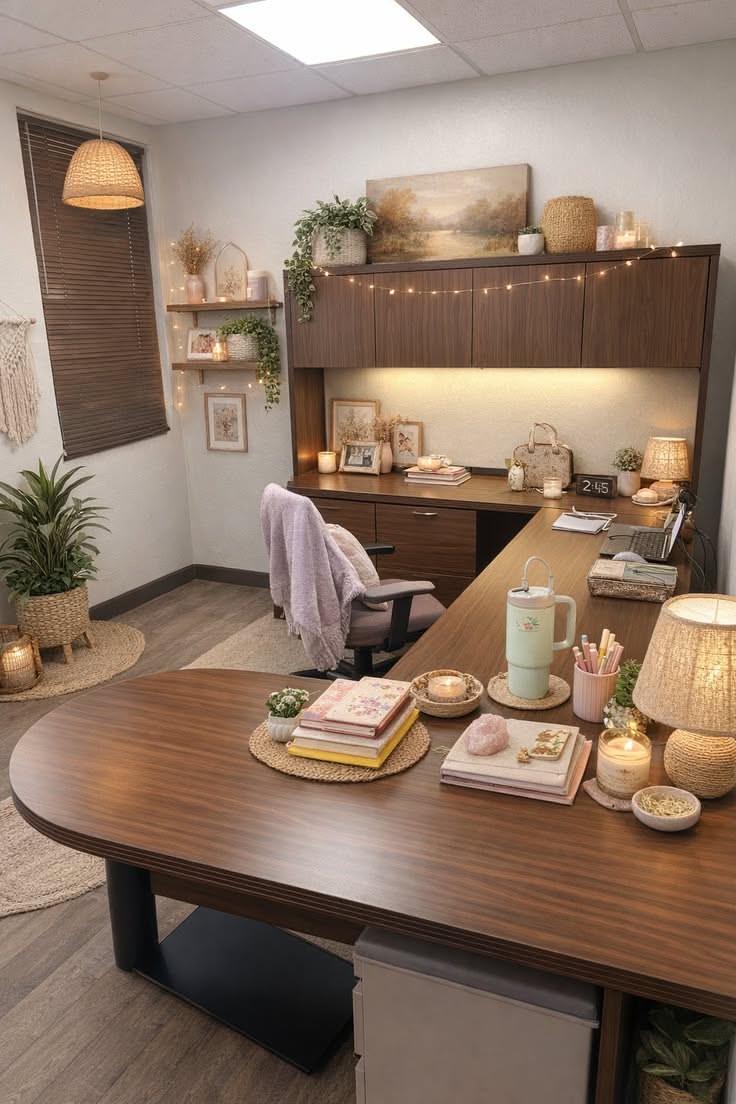
A spacious office can become cluttered just as easily as a small one if every open surface turns into storage. This setup uses cabinetry, shelving, and carefully grouped desktop accessories to keep the large work area usable. Decorative pieces add warmth without overwhelming the room. Keep this example in mind if your challenge is not lack of space, but preventing extra space from collecting unnecessary items.
29. Combine Closed Boxes With Upright Files on Simple Shelves
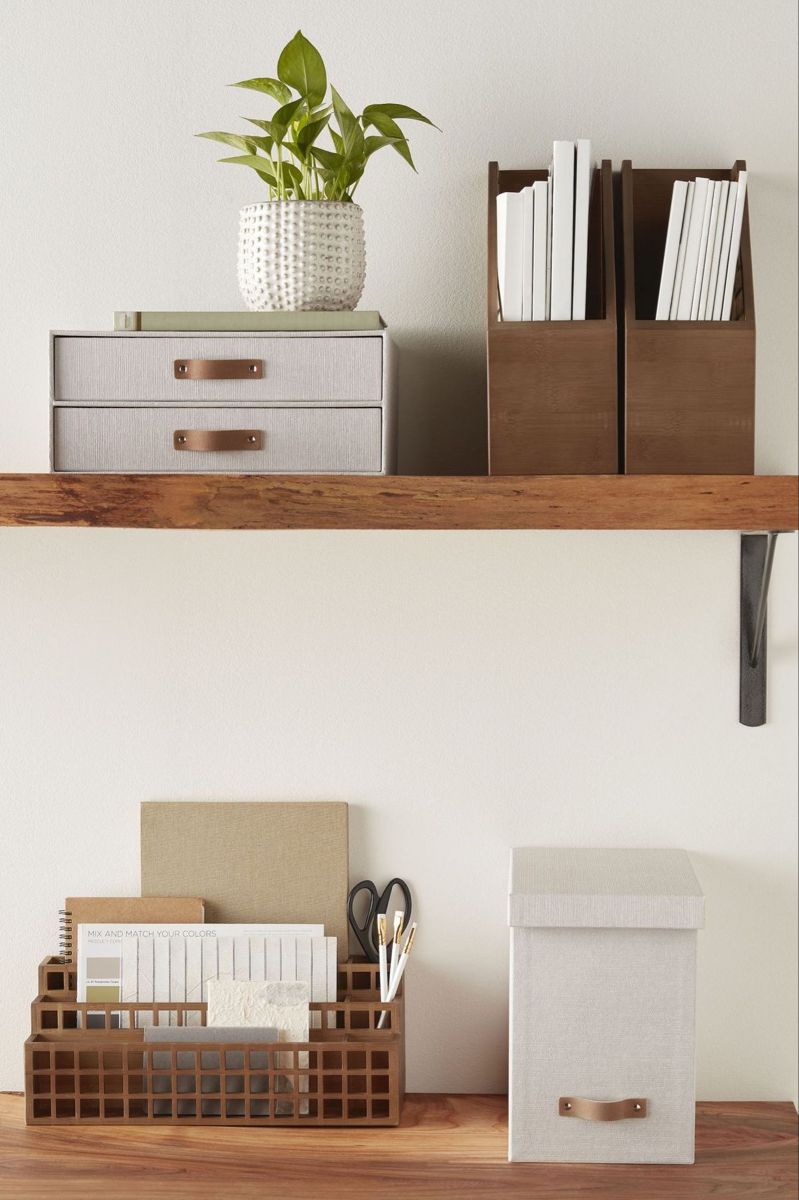
This pared-back storage arrangement proves that you do not need a huge system to create order. A few closed boxes hide smaller pieces, while vertical file holders keep books and papers upright instead of forming unstable stacks. The warm wood surface also keeps the setup from feeling overly utilitarian. Borrow this idea when you want a straightforward system that is easy to maintain.
30. Improve a Plain Office Through Layout Before Buying More Storage
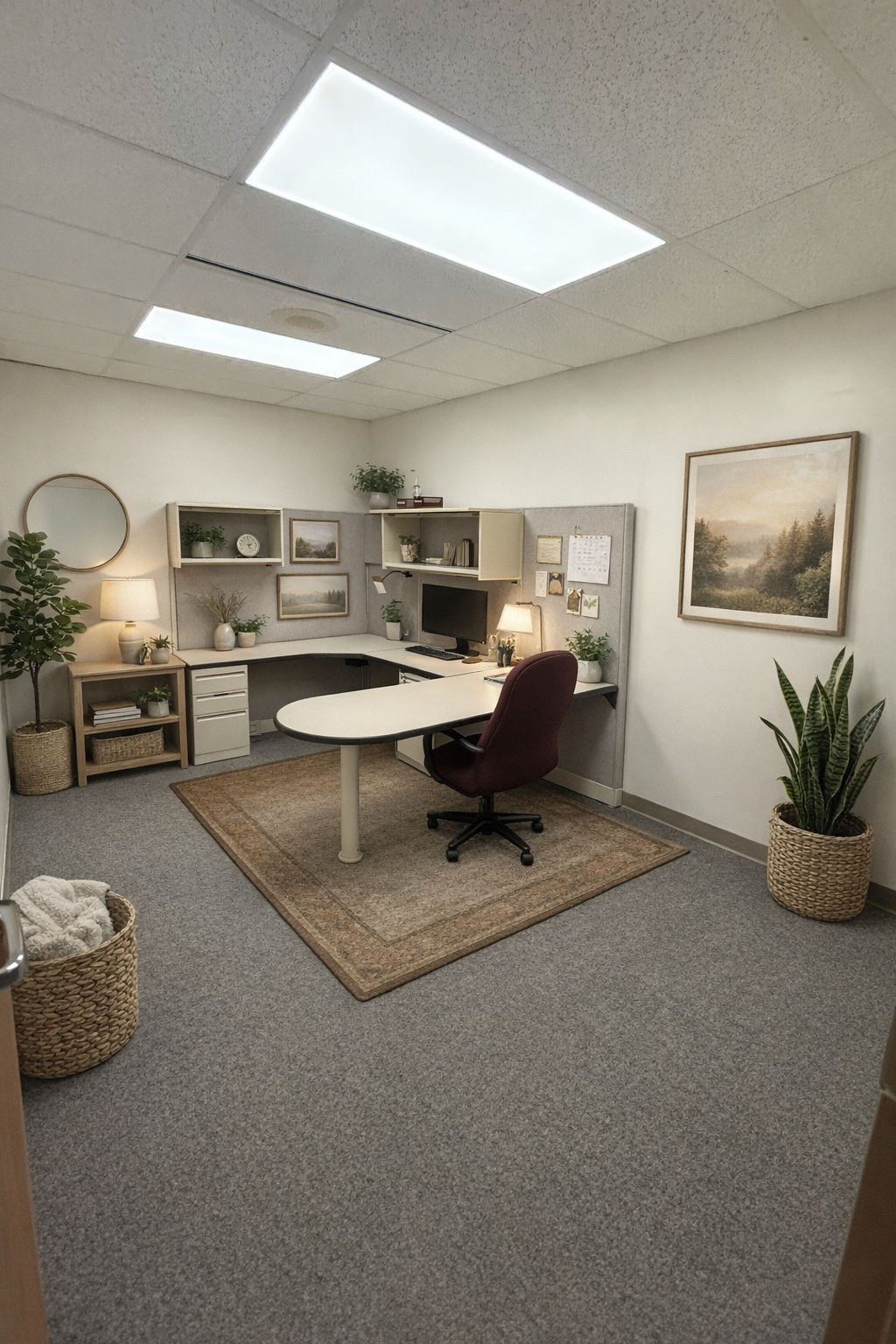
Sometimes organization improves simply by giving furniture and work zones more breathing room. This office uses an efficient corner workstation, nearby cabinets, open shelves, plants, and clear floor space to create a calmer environment. The lesson is useful for anyone tempted to solve every problem with another container. Use this image as motivation to rethink placement before adding more storage products.
31. Build a Compact Office Wall With Drawers, Shelves, and Tall Storage
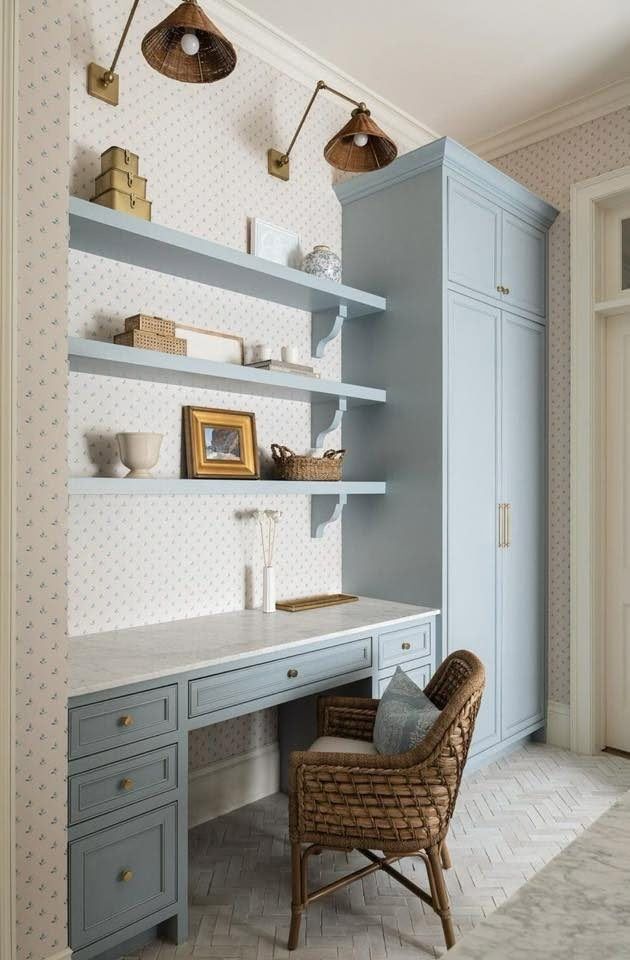
A built-in workstation can pack a significant amount of function into one wall. Drawers keep smaller office supplies hidden, open shelves provide accessible display space, and a tall cabinet absorbs bulkier items without expanding the desk footprint. The soft blue finish gives the entire setup a furniture-like quality. Save this configuration if you want one polished wall to handle most of your office storage.
32. Pair a Bright Window Desk With Built-In Storage
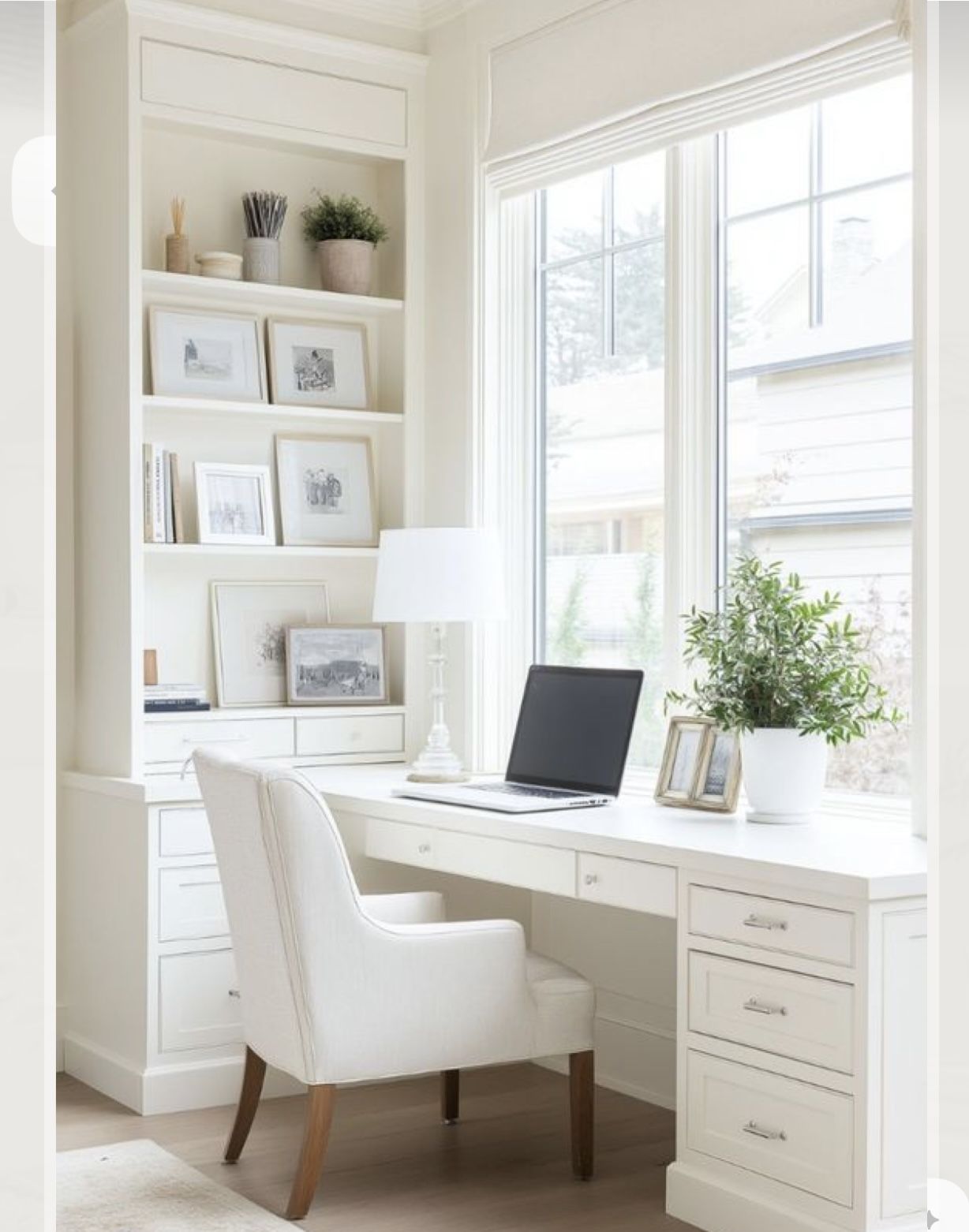
Natural light, a long work surface, drawers, and nearby shelving create a home office that feels open yet highly functional. The built-ins keep paperwork and office essentials close without allowing them to dominate the desktop. This approach works especially well when you want a permanent workspace that blends into the architecture. Add this bright setup to your board if airy organization appeals to you.
33. Give Paper, Mail, and Stationery Their Own Labeled Shelf
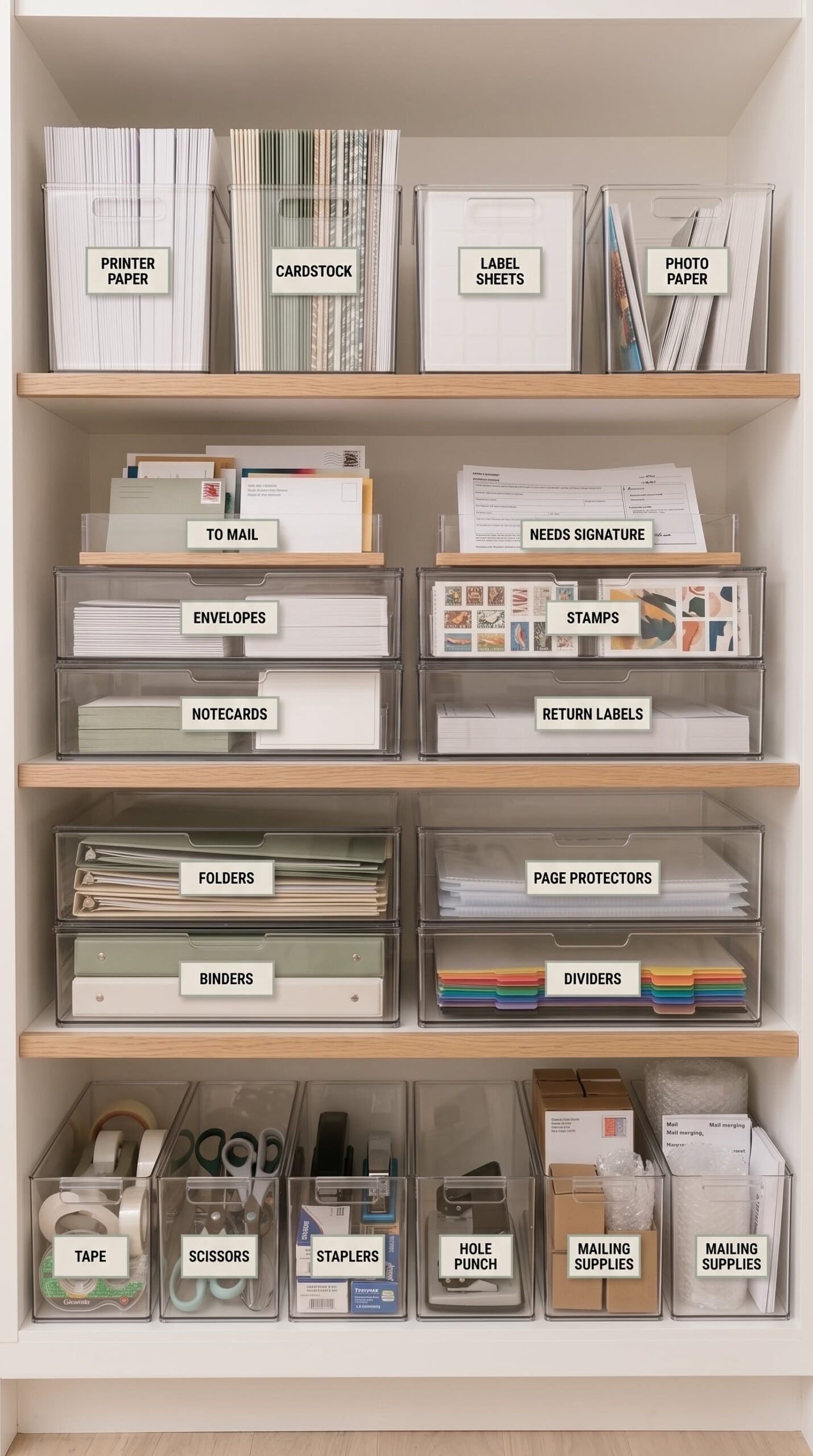
A dedicated office supply cabinet becomes dramatically easier to use when every category has a clear label. Printer paper, cardstock, mailing supplies, envelopes, folders, dividers, and tools can all remain separate instead of becoming one mixed collection. Transparent containers reinforce visibility and make restocking easier. Recreate this system if you regularly handle paperwork and want supplies to stay ready without searching through multiple drawers.
34. Make a Deep Desk Drawer Work Like a Custom Organizer
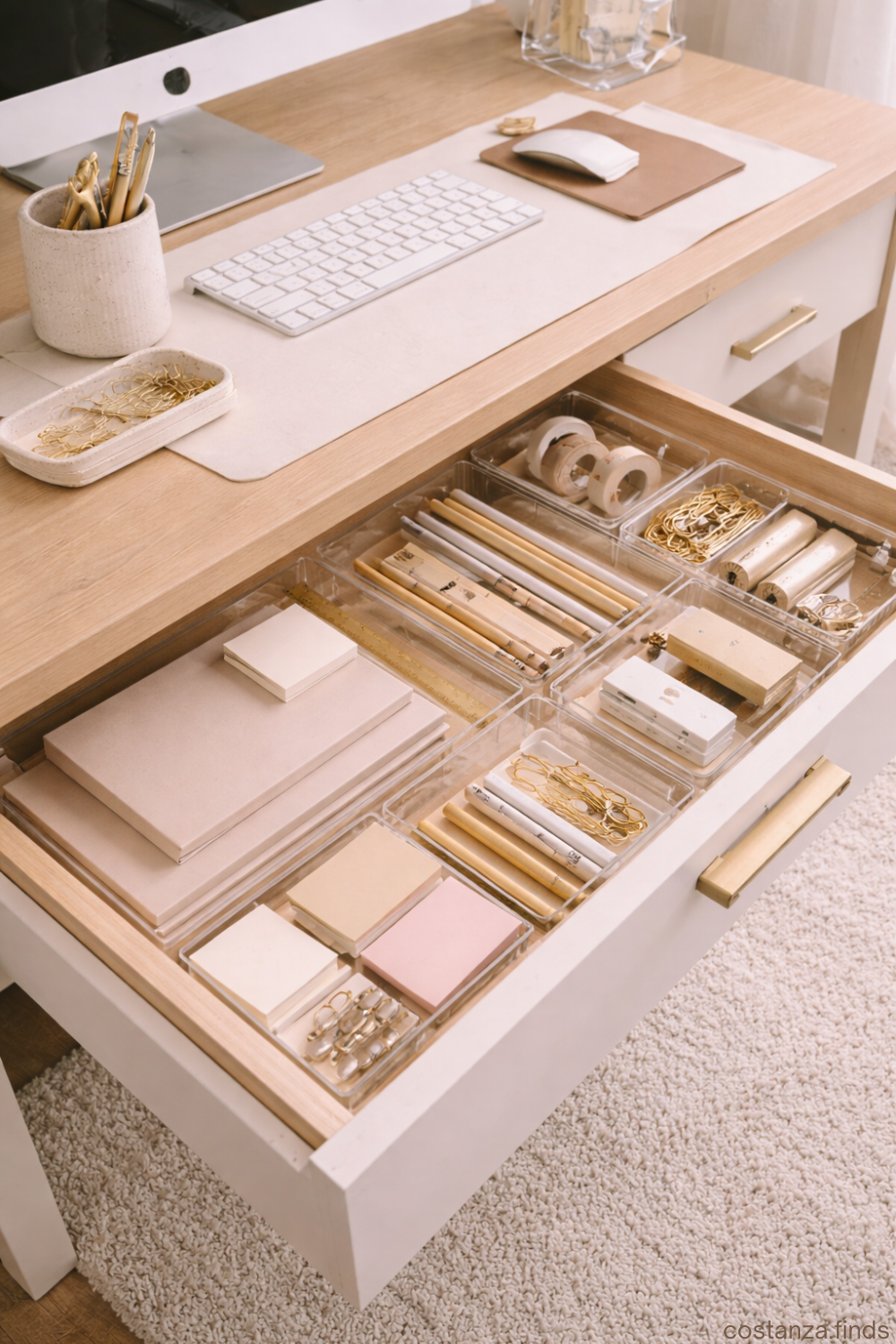
A wide drawer can become one of the most valuable areas in a home office when modular trays divide it into smaller functional zones. Notebooks, pencils, clips, tape, and stationery remain visible while the work surface stays nearly empty. The warm neutral palette also makes the storage feel intentionally designed. Keep this layout as inspiration for turning an underused drawer into everyday organization.
35. Use Clear Desktop Organizers to Keep Essentials Visible
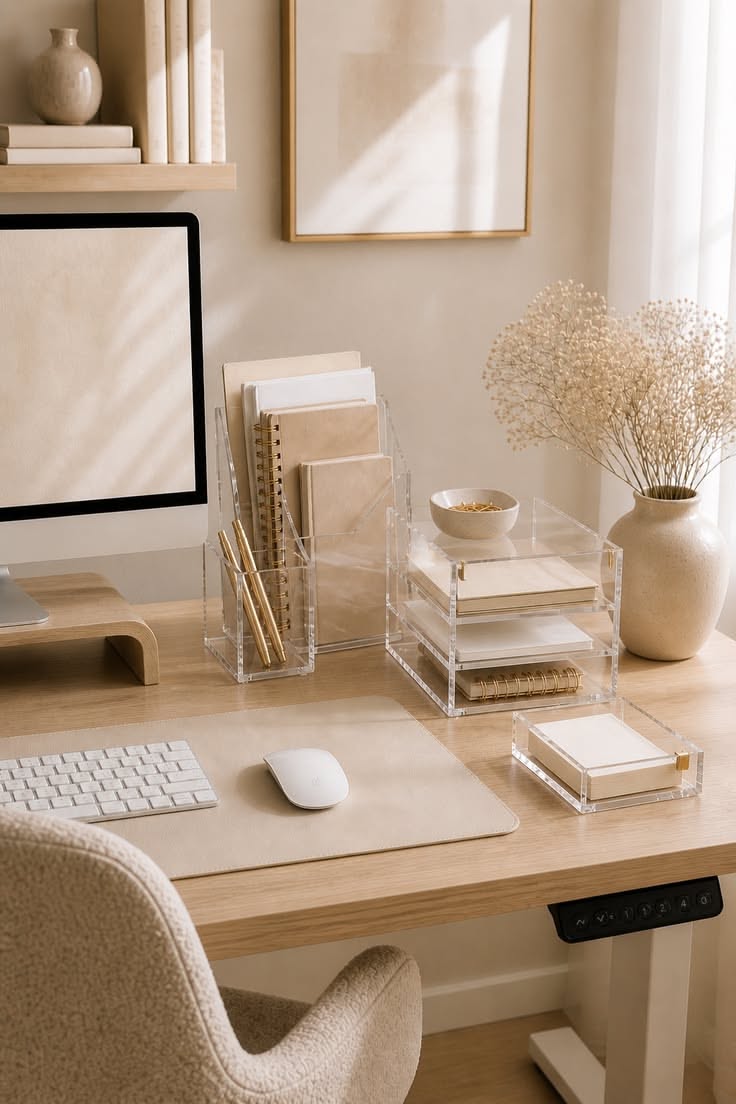
Acrylic organizers allow papers and notebooks to remain easy to reach while preserving a lighter visual feel than solid containers. This setup combines vertical files, stacking trays, and a small note holder without overwhelming the desk. It is particularly useful when you need quick access to active work. Try this direction if closed storage makes you forget what you have.
36. Solve a Small Office With Several Strategic Storage Moves
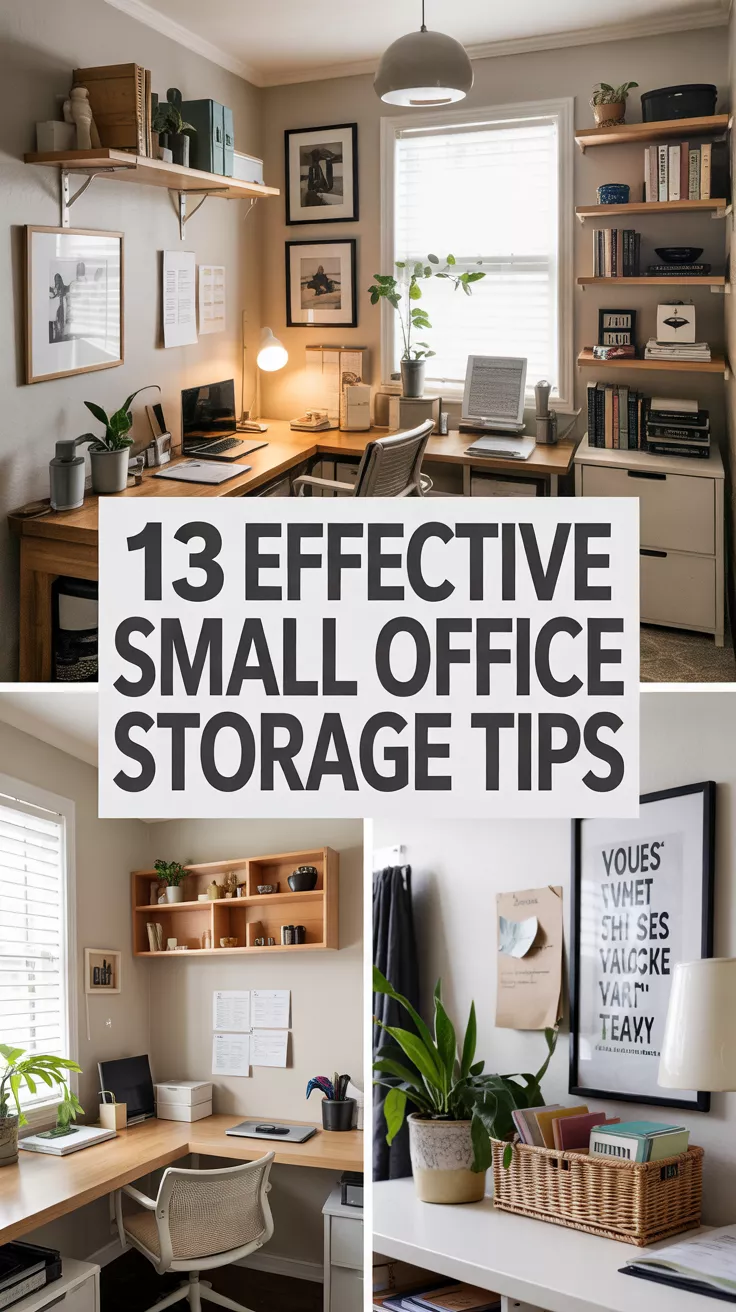
Small workspaces often benefit more from a collection of focused improvements than from one oversized storage piece. Shelves, baskets, desk organizers, and carefully placed furniture can each solve a specific problem while keeping the room flexible. This collage captures that layered approach well. Use it as inspiration for choosing two or three changes that address your biggest storage issues first.
37. Use a Tall Cabinet to Keep Supplies Organized but Out of Sight
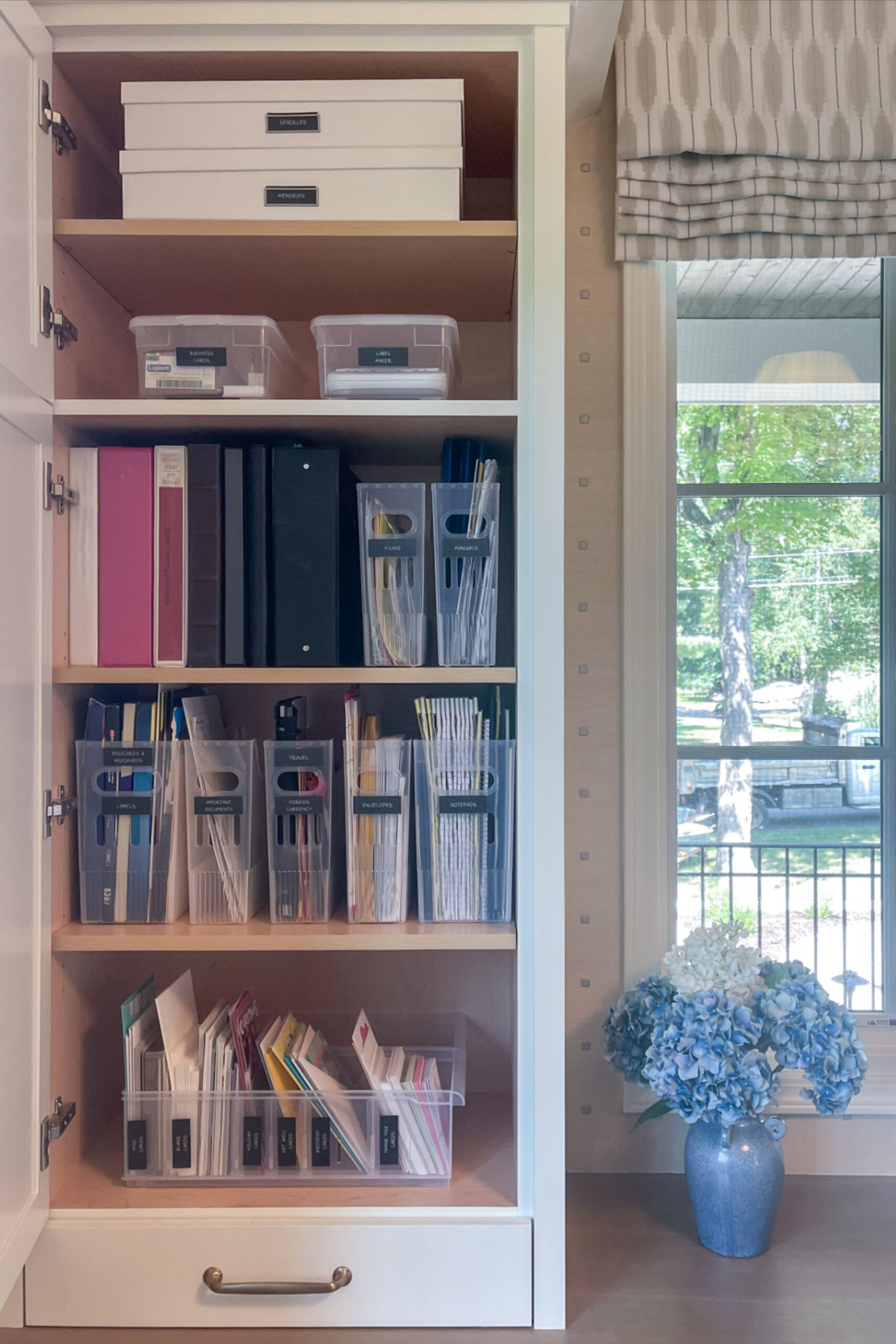
A tall cabinet creates valuable vertical storage while allowing the rest of the room to stay calm. Clear bins, binders, pens, envelopes, cards, and paper categories can all live together without spilling onto the desk. Because the doors can close, this setup offers the best of both visibility and concealment. Bookmark this idea if you want high-capacity storage that does not permanently dominate the room.
38. Build a Real-Life Paperwork Command Center
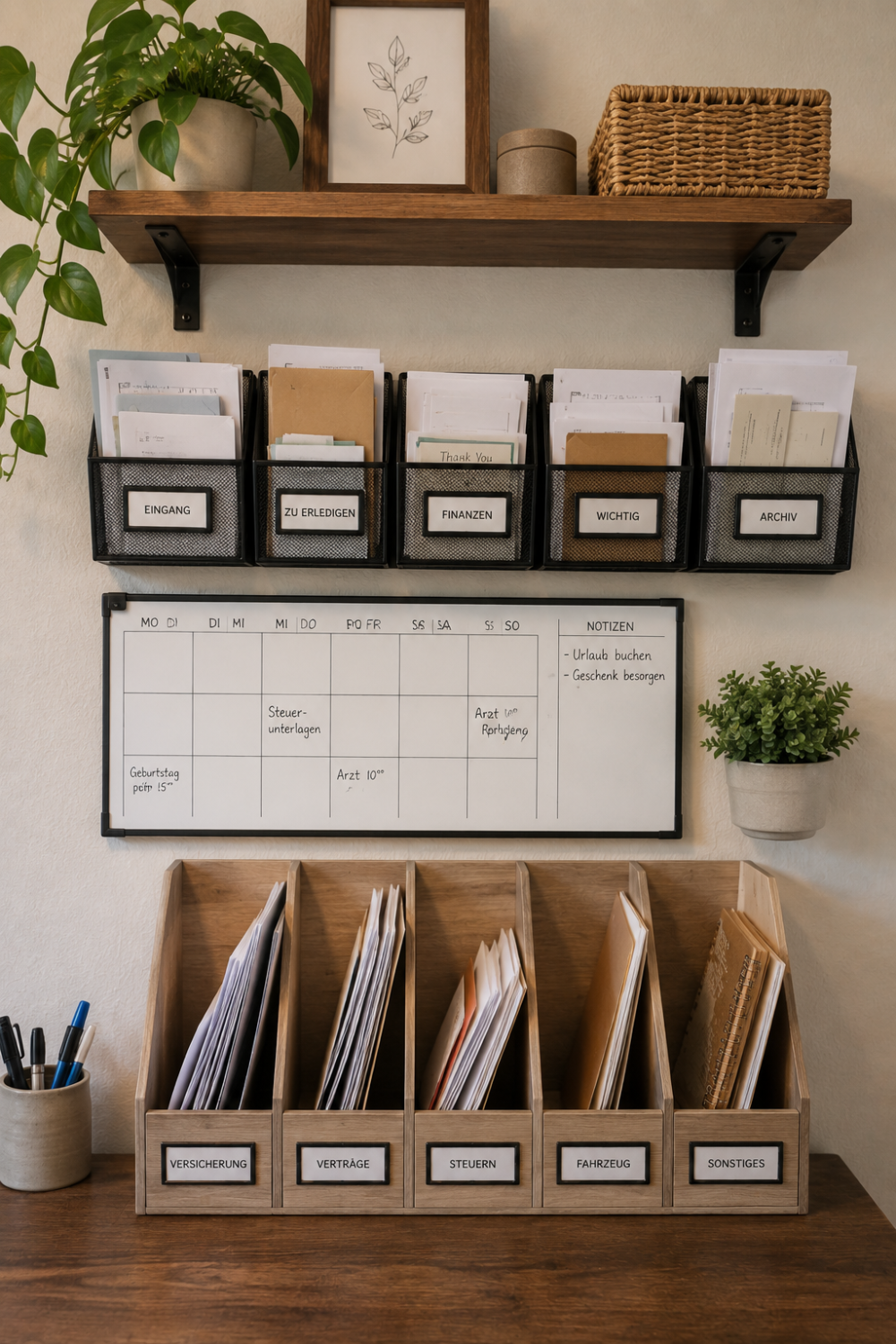
This wall system combines labeled document pockets, a weekly planner, vertical paper files, and a small shelf to create a practical administration zone. Incoming papers, tasks, finances, important items, archives, and longer-term files all have separate destinations. That structure makes everyday paperwork easier to process instead of postponing. Use this final setup as inspiration for creating a paper routine you can realistically maintain.
How to Choose the Right Office Organization at Home System
The best organization system starts with your actual workflow rather than the containers you like visually. Before buying anything, pay attention to what repeatedly becomes messy. If papers collect on your desk, prioritize files, wall pockets, or a paper command center. If office supplies are the problem, drawers, bins, and a dedicated supply cabinet may make a bigger difference. If technology causes clutter, focus first on charging, cable control, and equipment zones.
Your available space also matters. Small offices usually benefit from vertical storage because shelves, wall pockets, pegboards, and tall cabinets preserve valuable floor area. A larger office can handle more cabinetry, but the same principle applies: frequently used items should be easiest to reach, while seasonal or rarely used materials can move higher or behind closed doors.
Consider how much visual information you enjoy seeing. Clear bins and open shelves are useful when visibility helps you remember where things are. Closed cabinets and matching boxes create a calmer look if visible supplies feel distracting. A combination of both often works best.
Finally, make maintenance part of the design. Leave a little empty space in drawers, bins, and files instead of filling them completely. Give incoming papers a temporary landing zone, and make putting things away easier than leaving them out. The strongest office organization at home system is not the most elaborate one—it is the one you can reset quickly and continue using without constant effort.
What Are the Most Useful Home Office Organization Ideas?
The most useful home office organization ideas create specific homes for the categories that cause repeated clutter. A paper station, organized desk drawer, printer zone, vertical file system, charging station, and labeled supply storage can solve many common problems. Start with the category that interrupts your work most often, then add additional systems only when they serve a clear purpose.
Frequently Asked Questions About Office Organization at Home
How do I start organizing a cluttered home office?
Start by removing items that do not belong in the workspace, then group what remains into practical categories such as papers, technology, stationery, active projects, and archived materials. Give the most-used categories accessible storage first. You do not need to organize everything in one day; fixing the category that creates the most visible clutter can make the entire office feel easier to manage.
How can I organize a home office with very little space?
Use walls and vertical storage before adding more floor furniture. Floating shelves, wall pockets, tall cabinets, pegboards, and upright paper holders can increase storage while preserving walking and working space. Keep the main desktop dedicated to active work, and place less frequently used materials above or below it. Compact furniture with drawers or built-in storage can also help one piece perform several jobs.
What is the best way to organize paperwork in a home office?
Create a simple paper flow rather than one large filing category. A practical system might include incoming, action needed, to file, and archive sections. Wall pockets or trays work well for active paperwork, while file drawers or boxes suit documents you need to keep longer. The most important part is having an obvious destination for new papers before they become a pile.
How do I keep my office desk from getting cluttered again?
Limit the desktop to items you use every day and give everything else a nearby storage location. Small tools can go into drawer dividers, active papers into vertical files, and occasional supplies into bins or cabinets. A quick reset at the end of each work session also helps. When putting something away takes only a few seconds, staying organized becomes far more realistic.
Are clear containers or closed storage better for a home office?
Both can work well, but they solve different problems. Clear containers are useful for supplies you need to identify quickly, while closed storage creates a calmer visual environment by hiding busy categories. Many home offices benefit from combining them: use clear organizers inside closets and drawers, then choose more decorative boxes or cabinetry for storage that remains visible in the room.
How should I organize a printer area at home?
Keep the printer close to the supplies you use with it, including paper, labels, spare ink, and documents waiting to be processed. A cabinet, cube shelf, or rolling cart can create a dedicated printer zone without sacrificing the main desk. If possible, use nearby drawers or baskets for accessories so printing tasks stay contained in one area rather than spreading across the office.
How can office organization at home still look stylish?
Choose a limited palette of storage containers, repeat similar materials, and mix practical storage with a few decorative pieces. Woven baskets, matching boxes, warm wood, clear acrylic, plants, and framed art can soften functional systems. You do not need to hide every item; the goal is to make visible categories feel intentional while keeping the busiest supplies contained.
Final Thoughts
Good office organization at home should make your workday feel easier, not create another complicated system to maintain. The 38 ideas in this collection show how many different approaches can work: labeled office closets for high-capacity storage, acrylic organizers for visually light desks, command centers for household administration, vertical files for paperwork, and built-in cabinets for a more permanent solution.
Start with the problem that bothers you most. If paper piles are constantly returning, build a filing or wall-pocket system first. If supplies cover your desktop, move them into drawers, bins, or a rolling cart. If the entire office feels visually busy, simplify the surfaces and shift less attractive items into closed storage.
You can also mix ideas rather than copying one setup exactly. A minimal desk can still use a nearby supply closet, and a stylish shelving wall can sit beside a highly practical filing cabinet. The most successful workspace is the one that fits your routines, available space, and preferred level of visual simplicity.
Choose one idea that would make your current office easier to use, personalize it for your space, and build your organization system from there.